The History of Astrology Decans: Ancient Roots
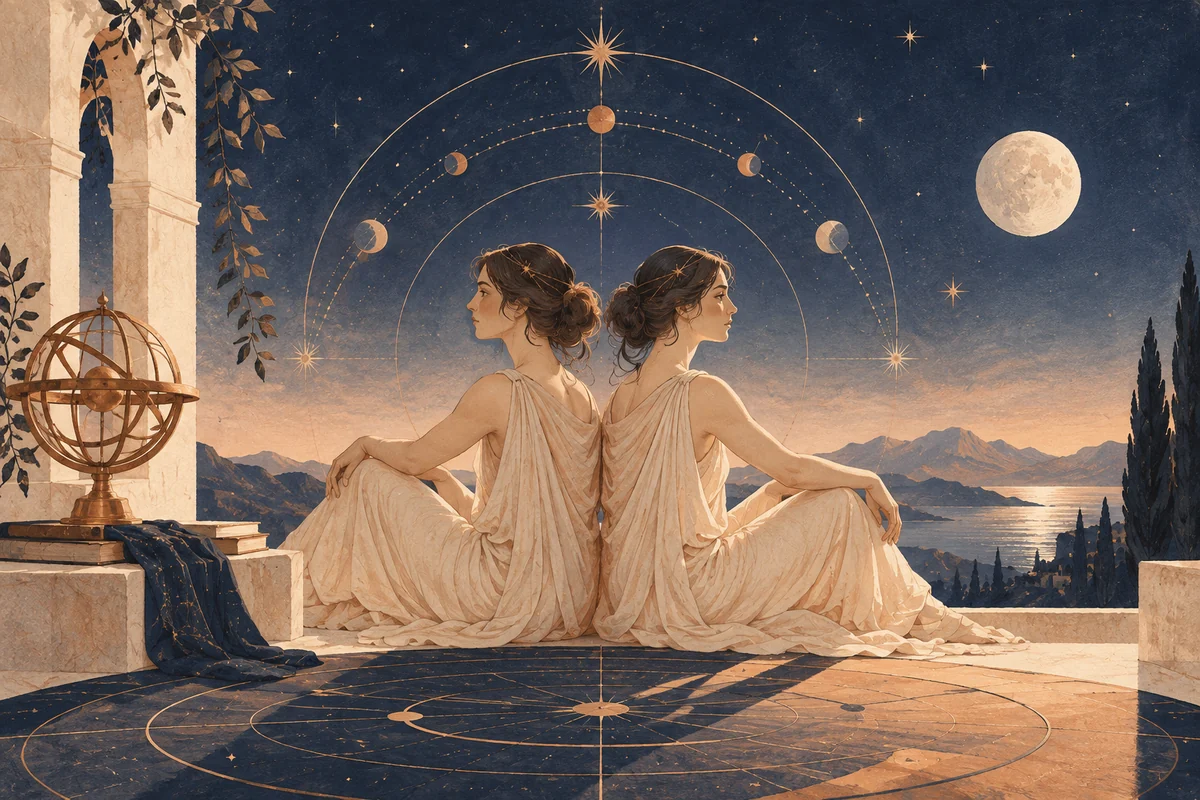
The history of astrology decans began in third-millennium BCE Egypt, where thirty-six star groupings originally measured the nocturnal hours before merging with the twelve Babylonian zodiac signs during the Hellenistic era. As Greek astrologers transformed these stellar timekeepers into ten-degree divisions known as faces, they assigned planetary rulers that added psychological nuance and dignity to natal interpretation. Today, these ancient subdivisions continue to enrich symbolic self-reflection, offering practitioners a detailed lens through which to explore archetypal planetary expressions.
Egyptian Origins: The Thirty-Six Stellar Clocks
Long before they were woven into astrological birth charts, decans served as practical star clocks in ancient Egypt. Surviving coffin lids from the Middle Kingdom, dating back to roughly 2100 BCE, display diagonal star tables depicting thirty-six distinct asterisms. Egyptian astronomers observed the heliacal rising of these specific stars, which appeared on the eastern horizon just before sunrise. Each decan ruled a ten-day period, known in classical Greek as a decade, producing a civil calendar of thirty-six ten-day weeks followed by five intercalary days to complete the solar year.
The primary purpose of these early decans was chronological and navigational rather than predictive. Priests tracked the rising of specific decanal constellations during the dark hours to tell the time of night, which proved essential for timing sacred temple rituals and agricultural preparations. Because different stars rose sequentially across the night sky, observers could divide the nocturnal period into twelve measurable phases. The most famous decan was Sirius, known to the Egyptians as Sopdet, whose heliacal rising heralded the annual flooding of the Nile River.
Over centuries, these stellar timekeepers absorbed profound religious significance. Egyptian cosmology associated each thirty-six-part division with protective deities and cosmic forces responsible for guarding the gates of the underworld. When texts like the Book of the Dead and temple inscriptions portrayed these stars, they attributed distinct spirits and therapeutic powers to each division. As Egyptian culture interacted with surrounding civilizations, these sacred star custodians laid the foundational framework for what would later become the thirty-six astrological faces of the classical Western tradition.
The Hellenistic Synthesis: From Star Clocks to Zodiacal Faces
The pivotal evolution in decanic history occurred following the conquests of Alexander the Great and the establishment of Ptolemaic Alexandria. In this cosmopolitan intellectual capital, Greek scholars encountered both Egyptian stellar lore and the twelve-sign zodiac recently imported from Babylonia. Astrologers realized that the thirty-six Egyptian decans mathematically harmonized with the twelve zodiacal signs of thirty degrees each. By dividing every sign into three equal segments of ten degrees, practitioners established thirty-six distinct divisions that they termed prosopa, an ancient Greek word meaning faces or masks.
Hellenistic authors like Teukros of Babylon, Nechepso, Petosiris, and later Vettius Valens incorporated these faces directly into natal interpretation. Unlike Egyptian asterisms, which were bound to actual physical constellations shifting slowly across millennia due to axial precession, Hellenistic faces became tied to the tropical zodiac. Each ten-degree face took on specific physical descriptions, character tendencies, and symbolic dangers. If a natal planet fell within a given face, astrologers considered its fundamental character colored by the spiritual costume of that particular ten-degree segment.
To systematize the meanings of these divisions, Hellenistic astrologers mapped planetary rulers onto the thirty-six faces using the Chaldean order. This system arranged visible planets by their perceived orbital speeds, descending from Saturn down to Jupiter, Mars, the Sun, Venus, Mercury, and the Moon. Starting with Mars ruling the first face of Aries, the sequence cycles through all thirty-six divisions in descending order. This assignment gave even detrimented or fallen planets an opportunity to possess essential dignity, as being in one's own face provided a modest yet supportive foundation.
The Indian Adoption and the Development of Drekkana
As Hellenistic astrological texts traveled eastward along trade routes during the second century CE, Indian astronomers absorbed decanic theory into Vedic astrology. The Yavanajataka, or Sayings of the Greeks, translated by Yavanesvara, formally introduced the thirty-six divisions to the subcontinent under the Sanskrit name drekkana or dreshkana. Rather than simply copying Hellenistic practices, Indian astrologers integrated the ten-degree divisions into their complex harmonic chart system, eventually making the drekkana one of the primary divisional charts, designated as D3 in modern Jyotish.
Indian practitioners introduced an alternative method of assigning planetary rulership to the decans that differed markedly from the Chaldean sequence. Instead of using planetary speed, this method employed triplicities based on the natural element of the sign. In the triplicity system, the first ten degrees of a sign are ruled by that sign's own lord, the second ten degrees by the lord of the next sign of the same element, and the third ten degrees by the lord of the remaining sign in that triplicity. This symmetrical method gained immense popularity across Asia.
The drekkana also retained the vivid descriptive imagery characteristic of Hellenistic faces. Classical Indian texts like the Brihat Jataka of Varahamihira describe each drekkana as an anthropomorphic figure bearing weapons, wearing colorful garments, and displaying intense emotional postures. Astrologers frequently consulted the drekkana to analyze an individual's courage, innate vitality, sibling relationships, and the spiritual inclinations shaping their personal destiny. This cross-cultural development showed how adaptable decanic divisions were when integrated into diverse metaphysical frameworks.
Tracing the History of Astrology Decans in the Middle Ages
During the medieval era, Arabic and Persian scholars revitalized the history of astrology decans by preserving and expanding classical Greek texts. Masters such as Abu Ma'shar synthesized Hellenistic face lore with Indian drekkana descriptions, creating comprehensive encyclopedias of astral imagery. Islamic scholars examined both the Chaldean planetary ordering and the triplicity method, providing thorough commentaries on how these ten-degree segments modified chart interpretations. Decanic studies flourished in centers of learning like Baghdad, where scholars viewed astrology as an interconnected branch of natural philosophy, mathematics, and optics.
Medieval astrological practice also tied the decans closely to talismanic magic and the occult sciences. The famous tenth-century grimoire Ghayat al-Hakim, later translated into Latin as the Picatrix, provided intricate recipes for engraving images of the decans onto gemstones to channel planetary spirits. Each decan was envisioned as a living, daimonic force possessing distinct medical, psychological, and magical virtues. Practitioners believed that casting talismans while the Moon or ascendant occupied a specific decan allowed them to harness subtle celestial forces for healing, protection, or personal influence.
When these translated texts returned to Western Europe during the twelfth-century translation movement, decanic imagery seized the Renaissance imagination. Scholars such as Marsilio Ficino and Heinrich Cornelius Agrippa studied decans as archetypal mirrors of the human psyche and the cosmic soul. Magnificent artistic examples survive from this period, most notably the fifteenth-century astrological frescoes in the Palazzo Schifanoia in Ferrara, Italy. There, master painters rendered the thirty-six decans as enigmatic allegorical figures, blending Egyptian mystery, classical mythology, and medieval courtly fashion across twelve majestic zodiacal panels.
Decans in the Tarot and the Victorian Esoteric Revival
In the late nineteenth century, the history of astrological faces took another dramatic turn with the founding of the Hermetic Order of the Golden Dawn in England. Esotericists like S. L. MacGregor Mathers sought to construct an overarching system uniting Kabbalah, astrology, alchemy, and Tarot into a coherent symbolic language. The Golden Dawn mapped the thirty-six minor arcana cards, specifically the numbered cards from Two through Ten across the four suits, directly onto the thirty-six astrological decans, excluding the Aces and court cards.
Under this synthesis, each Tarot card embodied the specific planetary energy ruling its assigned decan within the tropical zodiac. For example, the Two of Wands was paired with the first decan of Aries, governed by Mars, while the Three of Wands corresponded to the second decan of Aries, governed by the Sun. This pairing allowed occultists to interpret the minor arcana not merely as arbitrary divinatory fortunes, but as precise visual expressions of celestial mechanics. The Golden Dawn's system established an enduring bridge between card divination and astrological timing.
Artist Pamela Colman Smith, working under the direction of Arthur Edward Waite, illustrated these concepts in the iconic Rider-Waite-Smith Tarot deck published in 1909. While Smith incorporated rich narrative imagery, many scenes subtly echo the emotional and symbolic atmosphere of classical decanic descriptions. The burdened figure in the Ten of Wands, matching the Saturn-ruled final decan of Sagittarius, or the anxious sleeper in the Nine of Swords, reflecting Mars in Gemini, demonstrate how ancient decanic archetypes quietly inform modern visual culture and contemporary psychological reflection.
Modern Perspectives: Decans in Contemporary Astrological Practice
In modern astrology, practitioners actively utilize decans to add nuance and depth to natal chart interpretation. Contemporary psychological astrologers often find that describing a zodiac sign purely through broad sun-sign archetypes leaves out significant variations in personality. By observing which decan holds the Sun, Moon, or rising sign, an astrologer can explain why two individuals sharing the same sun sign exhibit remarkably distinct motivations. For instance, a first-decan Leo often projects pure solar vitality, whereas a third-decan Leo incorporates the restless, intellectual curiosity traditionally associated with Aries or Mars.
Today, astrologers freely choose between the traditional Chaldean system and the modern triplicity method popularized by Alan Leo in the early twentieth century. Traditional astrologers who practice Hellenistic or medieval techniques frequently prefer the ancient Chaldean rulers, emphasizing their essential dignity in horary and electional astrology. Conversely, psychological and modern practitioners often favor the triplicity method, finding that viewing each sign through the lens of its fellow elemental signs provides an intuitive, user-friendly model for counseling clients and exploring personal growth.
Ultimately, studying the history of astrology decans reveals astrology as a dynamic, evolving dialogue between human observation and celestial patterns. Decans survived the transition from Egyptian star clocks to Greek geometric charts, traversed medieval Islamic laboratories, inspired Renaissance palace walls, and revitalized twentieth-century Tarot decks. By engaging with these ten-degree segments today, we connect with thousands of years of human contemplative history, using ancient cosmic symbols to reflect deeply upon the complex, multifaceted dimensions of our inner lives.
Frequently asked questions
What is the primary difference between Egyptian decans and Hellenistic decans?
Egyptian decans were thirty-six physical star clusters used primarily as night clocks and seasonal calendar markers. Hellenistic decans, conversely, were abstract ten-degree divisions of the twelve signs of the tropical zodiac. Greek astrologers detached decans from individual visible asterisms and linked them directly to mathematical sign boundaries and planetary rulerships.
Which planetary ruler system for decans is older: Chaldean or triplicity?
The Chaldean order is the older documented system for Western decans, tracing back to Hellenistic astrology in the first few centuries BCE. The triplicity method gained prominence in classical Indian astrology around the second century CE before being popularized in Western modern psychological astrology during the early twentieth century.
How do decans connect to Tarot cards?
The Hermetic Order of the Golden Dawn mapped the thirty-six numbered minor arcana cards (Twos through Tens of all four suits) to the thirty-six decans. Each card represents the planetary ruler and sign quality of its specific ten-degree segment, which heavily influenced the classic Rider-Waite-Smith illustrations.
Why are decans sometimes called faces in traditional astrology?
Hellenistic astrologers used the Greek word prosopa, translating to faces or masks, to describe decans. Practitioners conceptualized each ten-degree division as a distinct theatrical or spiritual mask that colored the outward appearance and behavioral expression of any planet situated within its degree boundaries.