How to Read Sun Moon and Rising Compatibility
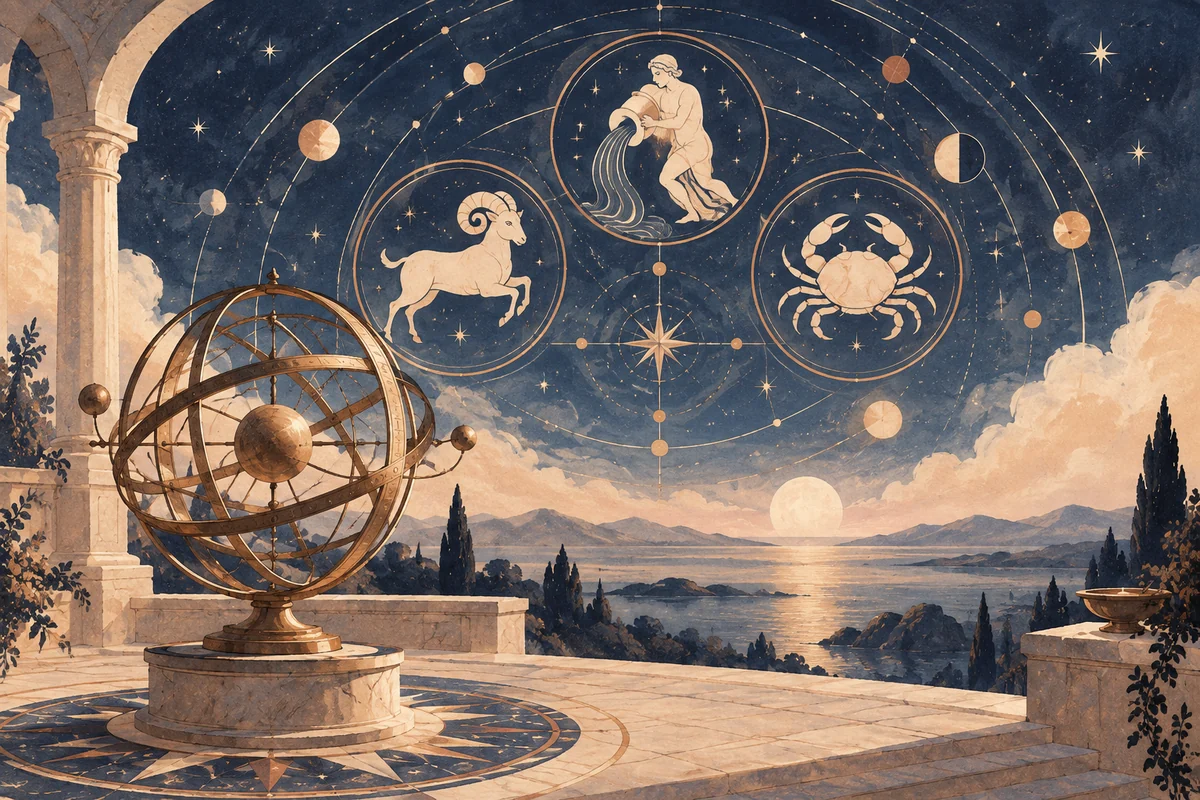
Sun moon and rising compatibility evaluates relationship harmony by comparing the three core pillars of two birth charts rather than relying on solar signs alone. In Western astrology, this technique analyzes how your conscious identity, emotional instincts, and outer social style interact with another person across nine distinct cross-placements. Examining these archetypal dynamics offers a grounded, reflective framework for understanding communication styles, shared values, and potential areas of friction.
Understanding the Role of the Big Three in Synastry
In modern Western astrology, relationship synastry begins with the Big Three: your Sun, Moon, and Rising signs. While traditional pop astrology attempts to gauge romantic success by comparing birthdays alone, serious practitioners view the Sun as merely the starting point. Your Sun represents core consciousness, personal vitality, and the values that drive your sense of purpose. When two Suns align harmoniously, such as Fire meeting Air, partners often feel validated in their essential ambitions and worldview.
Your Moon sign reflects inner emotional instincts, subconscious habits, and attachment needs. It describes what makes you feel safe behind closed doors when the demands of the world recede. In synastry, lunar harmony often dictates domestic peace, emotional validation, and the instinctive rhythms of cohabitation. If two partners have conflicting Moon elements, they might misinterpret each other's emotional responses, leading to unintended distance during times of high stress.
The Rising sign, or Ascendant, marks the eastern horizon at the precise minute of your birth and establishes the framework of the twelve astrological houses. It represents your social persona, physical demeanor, and initial energetic impression. When you meet someone new, their Rising sign interacts with your immediate perception before you uncover their deeper emotional layers. Harmonious Rising connections often create effortless initial attraction, fluid conversation, and mutual comfort in shared social environments.
Gathering Birth Data and Chart Foundations
To evaluate your sun moon and rising compatibility accurately, you must first calculate exact birth charts for both individuals. While determining a Sun sign requires only a calendar date, discovering an accurate Moon sign and Rising sign demands precise birth times and geographic coordinates. The Moon changes zodiac signs approximately every two and a half days, meaning a difference of a few hours can shift the lunar sign entirely.
The Rising sign is even more sensitive to timing, changing signs roughly every two hours as the Earth rotates. An incorrect birth time will skew the Ascendant and displace the house cusps, producing an inaccurate diagnostic map. You can obtain birth times from official state birth certificates, baby books, or family records. Reputable online ephemerides and chart calculators will then plot the exact degrees of each luminary and angle.
Once you calculate both profiles, write down the sign, element, and modality for each placement in two parallel columns. The four elements are Fire, Earth, Air, and Water, while the three modalities are Cardinal, Fixed, and Mutable. Having these foundational details clearly organized allows you to spot patterns of symmetry, balance, or tension before analyzing individual planetary pairings.
The Nine Big Three Cross-Connections Explained
Synthesizing two complete Big Three profiles requires examining nine cross-placements. You will compare your Sun to their Sun, Moon, and Rising; your Moon to their Sun, Moon, and Rising; and your Rising to their Sun, Moon, and Rising. Each connection illuminates a specific dimension of relationship dynamics. For instance, Sun-to-Sun comparisons describe shared creative purpose, while Moon-to-Moon comparisons reveal emotional safety and domestic compatibility.
The classic Sun-Moon cross-aspect is traditionally regarded as the gold standard of long-term partnership in Western astrology. When one person's conscious identity illuminates the other person's emotional instincts, both people tend to feel deeply understood and instinctively appreciated. If your Sun shares an element or forms a favorable trine with your partner's Moon, your natural ways of asserting yourself tend to fulfill their emotional needs without conscious performance.
Rising-to-Rising aspects determine social rhythm, collaborative pacing, and mutual physical presence. When Rising signs share a compatible element, partners often discover that their daily routines, social priorities, and lifestyle preferences align naturally. Conversely, if your Rising sign squares your partner's Rising sign, you may experience minor friction regarding how you entertain guests, organize your home, or present yourselves as a united team in public spaces.
Evaluating Elemental and Modality Balance
Analyzing elements provides rapid insight into how energy flows between two individuals. The four elements interact according to established astrological principles. Fire signs (Aries, Leo, Sagittarius) naturally harmonize with Air signs (Gemini, Libra, Aquarius), inspiring intellectual curiosity, shared enthusiasm, and adventurous social engagement. Earth signs (Taurus, Virgo, Capricorn) find organic synergy with Water signs (Cancer, Scorpio, Pisces), fostering emotional grounding, practical loyalty, and enduring domestic stability.
Elemental differences do not denote failure; rather, they highlight complementary strengths that invite conscious growth. A partner with a Water Moon can teach an Earth Moon partner how to access deeper vulnerability, while the Earth Moon provides a steady container for intense feelings. However, significant elemental disparities across all three placements, such as purely Fire profiles interacting with purely Earth profiles, require deliberate patience to translate different psychological needs into mutually supportive actions.
Modalities reveal how you and your partner process momentum and resolve everyday disputes. Cardinal signs initiate action and establish leadership, Fixed signs preserve stability and sustain focus, and Mutable signs adapt to change and navigate transitions. When two people carry predominantly Fixed placements, stubborn impasses can emerge during disagreements. A balanced distribution of modalities across both Big Three profiles ensures that a relationship possesses both the drive to begin projects and the flexibility to adapt over time.
Step-by-Step Synthesis of Two Full Profiles
To synthesize two charts, begin by assessing the Moon-to-Moon relationship, as emotional security forms the foundation of sustained intimacy. Note whether the Moons share an element, form a supportive trine, or occupy opposing signs. Opposing Moons, such as Taurus and Scorpio, can create powerful attraction, but they require both partners to appreciate contrasting methods of processing vulnerability and seeking comfort.
Next, examine the reciprocal Sun-Moon cross-connections. Check whether Person A's Sun shares a sign, element, or harmonic aspect with Person B's Moon, and then evaluate Person B's Sun in relation to Person A's Moon. If one person's Sun supports the other's Moon but the reverse shows elemental friction, one partner may feel naturally sustained while the other occasionally feels emotionally unseen, highlighting an area where conscious reassurance is beneficial.
Finally, integrate the Ascendants into the synthesis. Compare how both Rising signs interact with each other and with the respective Suns and Moons. If Person A's Rising sign matches Person B's Sun sign, Person A naturally embodies qualities that Person B admires and strives to develop. This three-layered evaluation prevents oversimplified conclusions, offering a multidimensional portrait of relational harmony, practical synergy, and personal development.
Applying Astrological Reflection to Everyday Partnerships
Astrological synastry is most constructive when used as a reflective language for empathy rather than a deterministic verdict on romantic viability. No combination of signs guarantees effortless harmony, nor does any difficult configuration doom a relationship to failure. Conscious communication, mutual respect, shared ethical values, and emotional maturity remain the decisive elements of enduring partnerships in daily life.
When exploring your sun moon and rising compatibility, use identified tensions as prompts for curious self-inquiry. If an elemental square suggests differing emotional styles, invite open conversations about how you both prefer to receive comfort during difficult days. Astrological archetypes offer symbolic frameworks that help couples articulate complex emotional dynamics that might otherwise feel confusing or personal.
By moving past single-sign generalizations and mastering the synthesis of the Big Three, you gain a richer appreciation for your partner's distinct psychological architecture. This nuanced perspective transforms astrological study from casual entertainment into a thoughtful exercise in self-awareness, active listening, and relational care.
Frequently asked questions
What is the most important Big Three connection for long-term compatibility?
Astrologers traditionally consider the Sun-Moon cross-connection the most reliable indicator of long-term compatibility. When one partner's conscious identity supports the other partner's emotional instincts, both people tend to feel naturally validated. Moon-to-Moon connections are equally vital for daily domestic harmony and navigating vulnerability together.
Can two people be compatible if their Sun signs clash?
Yes. Conflicting Sun signs often present opportunities for personal growth when supported by harmonious Moon or Rising placements. If two people share compatible emotional needs through their Moons or effortless social chemistry through their Ascendants, they can easily build a resilient, fulfilling partnership despite differences in core solar expression.
Why is an exact birth time necessary for Big Three compatibility?
An exact birth time is required to calculate your Rising sign, which changes every two hours as the Earth rotates on its axis. The Moon also shifts signs every two to three days. Without a precise time, your Ascendant and lunar calculations may be entirely inaccurate.
What does it mean if my Rising sign matches my partner's Moon sign?
This synastry aspect often creates immediate emotional ease and mutual comfort. The Moon person typically feels safe, welcomed, and understood in the presence of the Rising person, while the Rising person intuitively recognizes the emotional expressions and unspoken needs of the Moon person.