What Are Zodiac Decans? The 3 Subdivisions per Sign
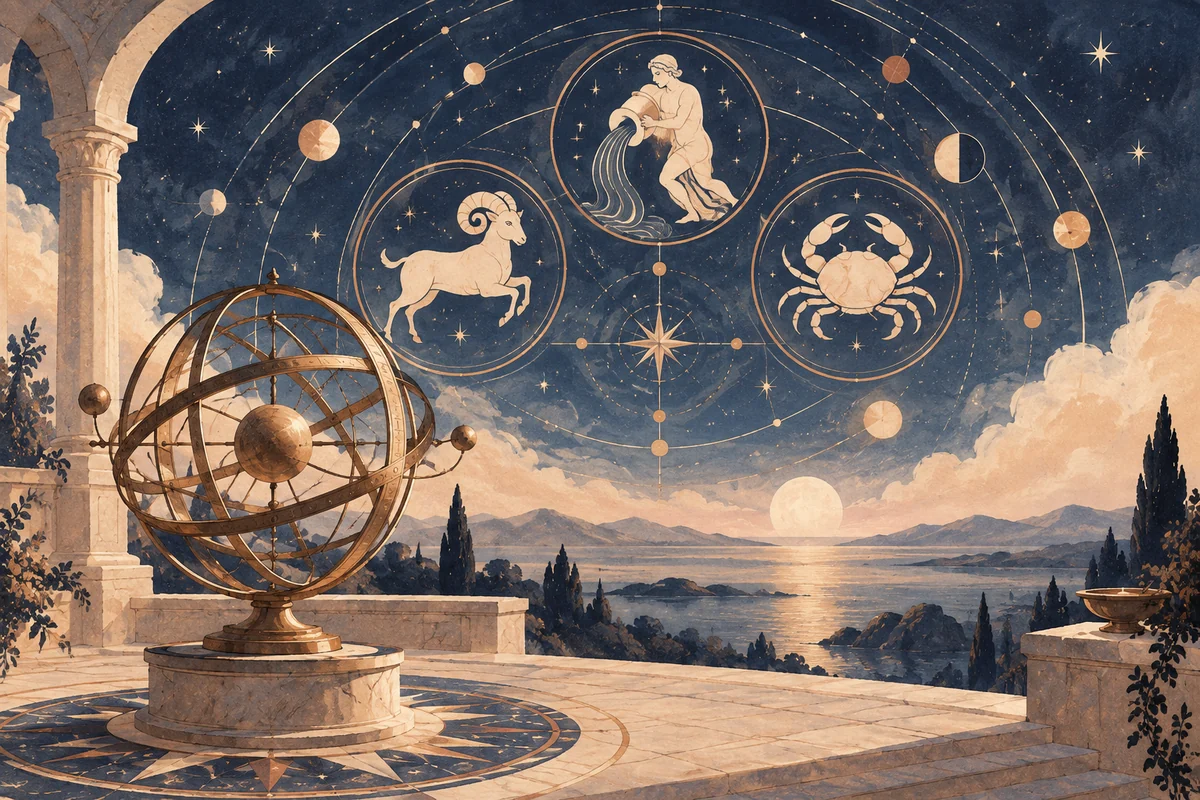
Zodiac decans are thirty-six subdivisions of the zodiac wheel that split each thirty-degree astrological sign into three distinct ten-degree segments. Each decan possesses its own planetary sub-ruler, which adds an extra layer of temperament, symbolism, and psychological nuance to planets placed within those specific degrees. By learning what zodiac decans are, practitioners can easily explain why two individuals sharing the exact same Sun sign often express their core traits in remarkably different ways.
Understanding What Zodiac Decans Are and How They Function
The word decan originates from the Greek word deka, meaning ten. In classical astrology, the celestial sphere is an unbroken circle of three hundred and sixty degrees, divided neatly into the twelve familiar zodiac signs of thirty degrees each. Because thirty divides evenly by ten, every sign naturally separates into three equal slices. The first decan spans from zero to nine degrees and fifty-nine minutes, the second decan covers ten to nineteen degrees and fifty-nine minutes, and the third decan encompasses twenty to twenty-nine degrees and fifty-nine minutes.
Astrologers traditionally view each sign as a primary archetypal landscape, but the decans provide distinct micro-climates within that territory. When a natal planet sits in a specific degree, it absorbs not only the baseline tone of the sign itself but also the nuanced flavor of the planetary sub-ruler governing that ten-degree territory. This structure allows astrologers to move beyond generalized descriptions and craft precise character studies that honor individual complexity.
Rather than changing your foundational sign, decans act as internal filters that emphasize particular values, communication habits, and instincts. For instance, an early Aries governed purely by Mars presents a noticeably different demeanor than a late Aries carrying the secondary influence of Jupiter. Understanding these mechanical divisions gives seekers a clear map for exploring why their personal inclinations may contrast with textbook astrological summaries.
Two Classical Systems: Modern Triplicity and the Chaldean Order
Astrological history preserves two primary methods for assigning planetary sub-rulers to the thirty-six decans: the triplicity system and the Chaldean order. The triplicity method, popularized in the modern era, assigns rulership based on the three signs belonging to the same element. In this framework, the first ten degrees of a sign are always co-ruled by that sign's primary governor. The second decan falls under the ruler of the next sequential sign within the same element, while the third decan belongs to the final elemental sibling.
The Chaldean system represents a far older tradition tracing back to Hellenistic and Egyptian astrological practices. Instead of organizing rulers by element, this system rotates planetary rulership according to the descending Chaldean order of visible celestial spheres: Saturn, Jupiter, Mars, the Sun, Venus, Mercury, and the Moon. Starting at zero degrees of Aries with Mars, the sequence repeats continuously across the thirty-six decans, returning periodically to create an entirely different symbolic landscape than the modern triplicity approach.
While traditional Hellenistic, medieval, and Tarot practitioners frequently rely on the Chaldean decans, most contemporary Western astrologers default to the elemental triplicity model. Neither system holds scientific proof, and both are interpreted as symbolic languages for self-inquiry. As you study your natal chart, comparing both methodologies can provide fresh creative perspectives on how planetary archetypes intersect within your inner life.
Fire and Earth Signs: Practical Nuances in Expression
Examining the elemental decans demonstrates how planetary sub-rulers shift behavioral tendencies across the zodiac. Within the fire element, Aries begins with a pure double-Mars decan focused on initiative and direct action. The second decan of Aries falls under the solar influence of Leo, cultivating pride and dramatic flair, while the third decan incorporates the expansive, philosophical optimism of Sagittarius and Jupiter. Leo and Sagittarius cycle through these exact same planetary rulers in elemental sequence, altering how their natural passion manifests.
The earth signs display a parallel evolution through practical manifestation. The first decan of Taurus carries the sensual, grounding influence of Venus, whereas the second decan incorporates the analytical, detail-oriented precision of Virgo and Mercury. The final decan of Taurus takes on the disciplined, enduring ambition of Capricorn and Saturn. These subtle rulership differences explain why one Taurus may lean toward hedonistic leisure while another shows relentless corporate ambition.
When reflecting on your placements in earth and fire, consider whether your planetary expressions lean more impulsive, strategic, or persevering. A Capricorn born in the Mercury-ruled Virgo decan may approach career ambitions through meticulous planning and communication, whereas a third-decan Capricorn influenced by Venusian Taurus might prioritize wealth preservation, aesthetics, and lasting material comforts above rapid professional ascent.
Air and Water Signs: Emotional and Intellectual Layers
In the air signs, decans modify mental styles, social needs, and patterns of abstract thought. Gemini starts with a double-Mercury decan emphasizing curiosity and swift speech, transitions into a Venus-influenced Libra decan that values collaborative diplomacy, and finishes with an Uranus- or Saturn-influenced Aquarius decan inclined toward unconventional ideologies. Libra and Aquarius repeat this elemental rotation, shifting each sign's cognitive balance between personal connection, structured ethics, and humanitarian vision.
Water signs reveal how emotional expression varies across ten-degree increments. Cancerian sensitivity manifests with lunar domesticity in its first decan, gains intense investigative depth through Scorpio and Mars or Pluto in its second decan, and adopts boundless spiritual empathy through Pisces and Jupiter or Neptune in its third decan. Similarly, Scorpio and Pisces undergo these cyclical shifts, proving that water signs are not universally fragile or uniformly defensive in their vulnerability.
These water and air subdivisions show how different individuals handle intimacy, boundaries, and emotional processing. A Pisces influenced by the lunar energy of Cancer often seeks home-centered emotional security, while a Pisces born in the third decan feels a double dose of Neptunian mysticism, yearning for artistic or philosophical transcendence. Reflecting on these sub-rulers can clarify personal reactions to conflict, collaboration, and solitude.
How to Find and Interpret Decans in Your Birth Chart
Locating your decans requires access to an accurate natal chart that lists the exact zodiacal degrees of your placements. Look at the number directly adjacent to the glyph of your Sun, Moon, or Ascendant. If your natal Sun sits at four degrees of Libra, it rests squarely in the first decan. A planet at fourteen degrees falls into the second decan, while a placement at twenty-five degrees occupies the third decan.
Once you determine the degree, identify which rulership tradition you wish to study. If you prefer the modern triplicity approach, check which sign of that element corresponds to your decan to find the secondary planetary ruler. If you want to explore classical traditions, look up the ancient Chaldean ruler assigned to that specific slice. You can then interpret the planet by blending the core needs of the sign with the energetic motivation of the sub-ruler.
Begin your interpretive practice with questions that bridge both archetypes. How does your primary sign define your underlying needs, and how does the sub-ruler color your outward method of fulfilling them? You might observe that while your core drive remains consistent with your Sun sign, your relational habits, creative hobbies, or defensive mechanisms closely mirror the distinct flavor of your decan's governing planet.
Synthesizing What Zodiac Decans Reveal for Personal Growth
Integrating the thirty-six divisions into chart reading allows for a more compassionate, tailored understanding of the human condition. Sun sign stereotypes frequently fall flat because they treat thirty degrees of complex human experience as a single monolithic identity. By investigating what zodiac decans are, you gain access to an ancient, multi-layered framework that honors the paradoxes and internal variations present within every personality.
Astrology functions best when approached as a contemplative mirror rather than an absolute predictor of fate. Decans do not lock you into fixed behaviors, nor do they dictate career success or emotional wellness. Instead, they provide evocative archetypal vocabulary that helps you examine personal strengths, identify potential blind spots, and appreciate the unique ways your character unfolds across time.
Whether you are examining your natal Sun, exploring your Ascendant's communicative style, or tracking the current transit of a planet across a sensitive degree, decans offer granular insight. Embracing these ten-degree subdivisions allows you to celebrate your individuality with greater precision, turning broad astrological archetypes into an intimate instrument for mindful self-reflection and personal evolution.
Frequently asked questions
Do zodiac decans change my real Sun sign?
No, decans do not change your fundamental Sun sign. Your primary sign remains the core landscape of your placement, while the decan adds an extra layer of planetary nuance and personality flavoring.
How do I know which decan I belong to?
You need to know the exact degree of your placement. Degrees zero through nine are in the first decan, degrees ten through nineteen are in the second, and degrees twenty through twenty-nine occupy the third.
Why do the triplicity and Chaldean decan systems differ?
The triplicity system assigns rulers based on the three signs sharing the same element, popular in modern astrology. The older Chaldean system assigns rulers using the ancient descending order of visible planets.
Can decans be applied to planets other than the Sun?
Yes, every planet, luminary, and angle in your natal chart occupies a specific degree and belongs to a decan. You can analyze your Moon, rising sign, Venus, or Mars through its assigned decan ruler.