Death Tarot Year Card 2027: Meaning & Calculation
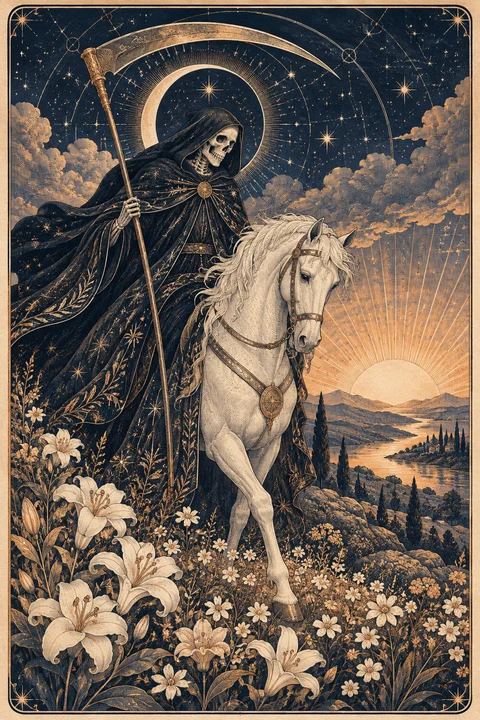
Your death tarot year card 2027 represents a profound twelve-month cycle focused on personal metamorphosis, intentional release, and meaningful psychological renewal. In modern numerological Tarot traditions, you arrive at this archetype when the sum of your birth month, birth day, and the universal year number 11 reduces to 13. Rather than forecasting physical events, this card serves as an introspective mirror that invites you to clear outworn patterns to make deliberate room for vital new growth.
How to Calculate Your Personal Tarot Year Card for 2027
Calculating your personal Tarot year card is a straightforward process based on modern numerological associations. To discover your theme for 2027, begin by calculating the universal year number. Adding the four individual digits of 2027 gives you two plus zero plus two plus seven, which equals 11. In this system, you take your calendar birth month and your birth day, add them together, and then add 11. Once you have that combined sum, you reduce the digits by standard addition until the total falls between one and 22, matching the traditional numbering of the Major Arcana.
Consider an individual born on January 1. January is the first month, so you add one for the month, one for the day, and 11 for the year 2027, yielding a total of 13. Another example is someone born on October 11. October is month ten, which combines with day 11 and year number 11 to produce 32; adding three plus two reduces that number to five. If your own calculation settles directly on the number 13, your symbolic archetype for the entire year is Death.
It is helpful to recognize that this mathematical method is a popular modern convention rather than an ancient metaphysical rule. Contemporary Tarot authors and teachers popularized these calendar associations in the late twentieth century as accessible frameworks for self-reflection. Because different readers occasionally utilize alternative reduction techniques, you can hold this calculation lightly, treating it as an insightful contemplative lens rather than an unyielding law of nature.
Understanding the Symbolism of Card 13 in the Tarot
In the traditional Rider-Waite-Smith deck, card number 13 depicts an armored skeleton riding a stately white horse across a field populated by figures from every walk of life. The rider carries a dark banner decorated with the five-petaled white rose, a historical symbol representing purity, vitality, and immortal renewal. In the far background, beyond a winding river, the sun rises steadily between two high towers. This visual contrast highlights that transition is an unavoidable universal truth, while simultaneously promising that illumination and dawn invariably follow every meaningful conclusion.
Astrologically, practitioners traditionally align card 13 with Scorpio, the fixed water sign associated with deep emotional transformation, psychological endurance, and regeneration. Scorpio explores the subterranean layers of human experience, fearlessly investigating what lies beneath superficial everyday surfaces. In esoteric symbolism, this archetype is not interested in sudden devastation, which is more commonly symbolized by the Tower. Instead, card 13 represents the organic, seasonal pruning of what has run its course, operating much like autumn leaves naturally falling to enrich winter soil.
When newcomers encounter this card, initial discomfort is completely understandable because modern culture often avoids candid conversations about endings. However, experienced readers view this archetype as one of the most liberating cards in the entire deck. Skeletons represent the foundational structure of the human body that survives long after transient flesh fades. Symbolically, encountering this archetype indicates an invitation to strip away artificial social masks, superficial habits, and dead weight so that your most authentic core can finally breathe.
Themes of Release, Transition, and Rebirth
Living through a year governed by card 13 generally means confronting lingering patterns that have exhausted their usefulness. Many people spend years holding onto outdated professional identities, stagnant creative projects, or emotional dynamics simply out of habit or fear of the unknown. When you work with this archetype, you are encouraged to examine where your energy feels depleted rather than restored. Acknowledging that a particular phase of life is complete does not diminish its past value; rather, it honors the natural rhythm of completion.
The primary challenge of this transition often stems from internal resistance rather than the transition itself. When individuals attempt to artificially preserve situations that are no longer viable, stress and fatigue inevitably accumulate. Practitioners describe this process as learning the art of conscious surrender, which is very different from giving up in defeat. Conscious surrender means accepting reality as it is, letting go of futile attempts to control external conditions, and trusting that clearing clutter creates fertile ground for fresh opportunities.
As old commitments fall away, you may experience a quiet fallow period before new growth becomes visible. Western society frequently demands continuous production and relentless optimism, yet nature demonstrates that rest and stillness are essential prerequisites for healthy creation. Allowing yourself to sit in the space between what was and what will be is central to this experience. This spacious pause gives your subconscious mind the necessary quiet to integrate past lessons and dream up authentic next steps.
What the Death Tarot Year Card 2027 Asks of You
Working intentionally with the death tarot year card 2027 requires honest self-inventory and a willingness to simplify your daily commitments. Throughout this year, you will likely be called to identify which obligations drain your spirit without contributing to your long-term personal well-being. This card asks you to decline requests that do not align with your true values, establishing firm personal boundaries that protect your peace. Streamlining your schedule allows your attention to consolidate around what genuinely matters most.
This archetype also demands compassion toward your own internal changes. It is entirely normal to feel a gentle sense of grief when closing out prolonged chapters, even when you know those endings are healthy and necessary. Allowing yourself to acknowledge emotional transitions without rushing to replace what was lost ensures that you process closures thoroughly. Giving yourself permission to mourn the completion of an era keeps your emotional landscape uncluttered and resilient.
Ultimately, this year asks you to take active responsibility for your self-reinvention. Instead of waiting for external circumstances to force shifts in perspective, you can proactively decide what attitudes and beliefs deserve to accompany you into the future. By clearing away outmoded self-concepts, you regain personal agency. You become the conscious designer of your next chapter, recognizing that ending what is stale is the single most effective way to invite genuine vitality into your life.
Reflection Questions and Journaling Prompts
Journaling provides an exceptional anchor during periods of significant personal transition. Setting aside twenty minutes once a week to write without self-censorship allows your inner wisdom to surface without external noise. When you reflect on paper, subconscious fears lose much of their power because you can examine them with neutral curiosity. You may find it helpful to focus your writing around the specific areas of life where you feel the greatest friction, as friction usually highlights where transition is trying to take place.
To begin your reflective practice, consider asking yourself several focused questions throughout the months ahead. What belief about my capabilities or identity have I outgrown over the past several years? Where in my daily life am I holding on out of fear, comfort, or routine rather than genuine enthusiasm? What would my schedule and emotional state look like if I stopped trying to please everyone around me? How can I create more spaciousness in my living environment to reflect my inner desire for clarity?
You can also use physical decluttering as a tactile form of reflection. Sorting through books, clothing, and digital archives can mirror the psychological clearing asked for by card 13. As you hold an item or examine an old commitment, ask whether it reflects who you are today or who you used to be. Releasing items that belong to your past reinforces your psychological readiness to step forward unencumbered into your evolving future.
Embracing Renewal: Moving Forward With Your Death Tarot Year Card 2027
Navigating your death tarot year card 2027 is ultimately a celebratory journey toward greater personal authenticity and inner freedom. While the imagery of card 13 can seem stark at first glance, its core message is consistently one of hope, liberation, and profound empowerment. Shedding outlived obligations is not a punishment; it is the natural, healthy process through which every living thing maintains vitality, integrity, and grace across time.
Keep in mind that Tarot cards do not dictate unavoidable events or absolute destinies. Symbolism serves as a compass for mindful self-reflection, offering archetypal themes that you can interpret through the lens of your personal autonomy and wisdom. You remain the sole author of your choices, relationships, and goals throughout 2027 and beyond. Viewing this year through the mirror of card 13 simply reminds you that you have permission to evolve past yesterday's limitations.
As you walk through the coming months, treat yourself with continuous patience and understanding. Celebrate the courage it takes to say farewell to situations that have finished their teaching, and take pride in your capacity to adapt. By honoring the endings that arise naturally, you welcome the rising sun depicted on the traditional card, greeting your personal renaissance with clarity, confidence, and enthusiasm.
Frequently asked questions
Does getting Death as a year card mean something bad will happen?
No, it does not. In traditional Tarot symbolism, Death represents transformation, psychological shedding, and new beginnings rather than physical events or negative occurrences. Readers interpret this card as a helpful encouragement to leave behind outworn habits, outdated beliefs, and unfulfilling routines to create room for meaningful personal growth.
Is the Tarot year card system an ancient mystical rule?
No, the Tarot year card method is a popular modern system developed in the twentieth century. Contemporary teachers created it by blending basic numerology with Major Arcana symbolism to provide an accessible tool for annual reflection. It offers an insightful framework for contemplation rather than an ancient dogma.
How does the year 2027 connect to the number 11?
The year 2027 connects to 11 through simple digit addition: two plus zero plus two plus seven equals 11. In modern Tarot numerology, 11 serves as the universal year number for 2027, which is then added to your birth month and day to identify your personal year archetype.
What should I focus on during a Death year in Tarot?
Focus on simplifying your daily commitments, evaluating your boundaries, and letting go of identities or habits that no longer serve your well-being. This archetype invites you to declutter your emotional life, embrace quiet periods of rest, and trust the natural process of self-reinvention.