Tower vs 10 of Swords: How to Read Tarot's Rock Bottom
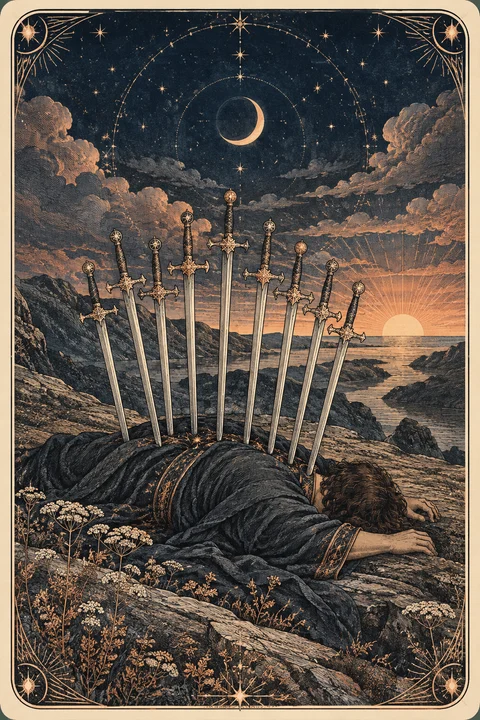
When comparing the Tower vs 10 of Swords, the core difference lies between sudden external catastrophe and cumulative mental exhaustion. The Tower represents an unforeseen collapse of false structures and illusions orchestrated by outside forces, while the Ten of Swords signifies rock bottom, mental burnout, and the absolute finality of an agonizing personal cycle. Understanding how these two cards operate helps readers distinguish between radical upheaval that demands rebuilding and quiet surrender that allows healing to begin.
Core Symbolism: Lightning Flash Versus Ten Blades
In the traditional Rider-Waite-Smith deck, The Tower bears the number sixteen among the Major Arcana, depicting a stone fortress crowning a mountain peak struck by sudden celestial lightning. Fire billows from the windows, a golden crown is blown off the summit, and two human figures tumble into the dark abyss below. This visual conveys shock, divinely orchestrated intervention, and the violent tearing down of hubris. Astrologically linked to Mars, the energy is sharp, loud, and uncompromising, tearing away anything built on false pride or shaky integrity.
Conversely, the Ten of Swords represents the culmination of the suit of Swords, which governs the intellect, perception, stress, and communication. The illustration depicts a lone figure draped in a crimson mantle, lying prone on the earth with ten swords driven into their back and spine. Above them, a leaden black sky blankets the landscape, yet along the horizon, water rests calmly and a bright golden dawn emerges. Where The Tower explodes upward in smoke and flame, the Ten of Swords lies flat in absolute stillness, embodying final defeat and the impossibility of further injury.
Contrasting their imagery reveals why readers find both cards intimidating yet fundamentally distinct. The Tower arrives without warning, pulling the rug out from under your feet and forcing you to confront reality without defenses. The Ten of Swords rarely arrives as a complete surprise; instead, it is the bitter, dramatic conclusion to an ordeal you likely saw unraveling for weeks or months. One is an explosion that clears the landscape, while the other is the exhausted collapse that finally ends the fight.
Major Arcana Fate Versus Minor Arcana Mental Exhaustion
A foundational distinction when examining the tower vs 10 of swords is their structural place within the deck. The Tower is a Major Arcana archetype, signaling universal evolutionary lessons, karmic reckonings, and profound milestones that reshape identity. When The Tower appears, the upheaval is rarely something an individual can micromanage, negotiate with, or intellectualize away. It forces a complete reassessment of life path, core beliefs, or domestic stability, operating as an inescapable cosmic reset that demands total humility.
The Ten of Swords belongs to the Minor Arcana, meaning it reflects day-to-day human drama, mindset patterns, and temporary psychological thresholds. While the imagery looks gruesome, readers often emphasize that the swords represent thoughts, assumptions, and verbal conflicts rather than literal violence. Ten is the number of completion, indicating that a painful thought pattern, anxiety spiral, or toxic relationship dynamic has run its course. It is an intellectual rock bottom where the mind simply cannot manufacture any more worry.
Because it is a Minor card, the Ten of Swords offers a clearer avenue for immediate personal agency once the pain is felt. You cannot prevent the lightning strike of The Tower, but you can choose to put down your role in the melodrama of the Ten of Swords. The Major Arcana reorganizes your outer circumstances, whereas the Minor Arcana asks you to acknowledge when a mental story has reached its undeniable expiration date.
External Upheaval Versus the Drama of Defeat
The felt experience of living through these cards could not be more polarized in tempo and origin. The Tower feels like an external ambush: an unexpected job termination, a sudden relationship confession, an eviction, or an abrupt realization that fundamentally shatters your self-image. It carries adrenaline, chaos, and disorientation. The ground disappears beneath you, and your immediate instinct is survival while sorting through what remains standing among the debris.
The Ten of Swords carries a heavier, slower, and often melodramatic emotional weight. Many practitioners note that having ten swords in a person's back is an obvious overkill, suggesting that the querent may be indulging in catastrophizing, playing the martyr, or succumbing to intense victimhood. It feels like utter exhaustion, emotional betrayal, burnout, or being utterly drained by prolonged conflict. The battle is already lost, and continuing to obsess over who caused the defeat only keeps you pinned to the ground.
Recognizing this difference changes how a querent navigates difficult news. When facing The Tower, practical disaster management and letting go of what cannot be saved are essential strategies. When facing the Ten of Swords, the primary work is psychological acceptance and emotional surrender. You do not need to fight back, defend your position, or analyze the failure further because the chapter is definitively over.
Love, Career, and Personal Crisis: Practical Interpretations
In relationship readings, these two cards diagnose trouble through distinct lenses. The Tower indicates a shocking rupture, such as an uncovered secret, a volatile argument, or an abrupt breakup that blows open unspoken resentments. It destroys pretenses, forcing both partners to look at the relationship honestly or part ways immediately. The Ten of Swords, on the other hand, suggests a dynamic that has died a slow, painful death through endless bickering, cold detachment, or unaddressed heartbreak, finally reaching an irrecoverable breaking point.
In career and financial spreads, The Tower often reflects unexpected corporate restructuring, sudden insolvency, sudden contract terminations, or a scandal that topples leadership. It disrupts daily routines overnight and requires people to pivot toward completely new avenues. The Ten of Swords frequently manifests as extreme professional burnout, staying in a toxic workplace until your health buckles, or taking on so many projects that you experience total mental paralysis and failure.
For personal growth and mental wellness spreads, neither card should be treated as a death sentence. The Tower asks: 'What fragile defense mechanisms or illusions are you clinging to that prevent your genuine evolution?' The Ten of Swords asks: 'Where in your life are you refusing to admit defeat, clinging to a lost cause simply to avoid the grief of starting over?'
Reversals: Resisting the Inevitable Versus Slow Recovery
Examining reversals provides nuanced insight into how querents handle rock bottom. The Tower reversed often indicates a desperate attempt to shore up a building that is already on fire. Practitioners describe this posture as dodging an uncomfortable truth, staying in denial, or delaying a necessary confrontation out of fear of conflict. In some readings, it can also signify a disaster narrowly averted, or the internal aftershocks following a major external trauma that occurred months ago.
The Ten of Swords reversed, however, carries one of the gentlest silver linings in the Tarot. While it can occasionally signify dragging out an agonizing ending or wallowing in despair, it most frequently represents pulling the swords out one by one. It signals the beginning of convalescence, the lifting of heavy depressive fogs, recovery from burnout, and rising from the floor after the worst has passed. The worst is confirmed behind you, and revitalization has commenced.
When comparing both reversals side by side, notice the directional flow of power. A reversed Tower usually prolongs tension because the unavoidable reckoning is merely postponed, keeping the querent suspended in anticipation. A reversed Ten of Swords generally signals the gradual reclamation of personal power, marking the quiet, tender morning after a long, dark night of the soul.
The Light Ahead: What Tower vs 10 of Swords Teaches Us
Despite their grim appearances, both cards function as essential catalysts for liberation and genuine self-awareness. Without The Tower, we would spend decades trapped inside rigid structures of our own making, defending false identities, dysfunctional careers, and artificial social standings. The lightning bolt is severe, but it clears the skyline, allowing fresh air, sunlight, and authentic foundations to take root where arrogance once stood.
Similarly, without the Ten of Swords, we might endlessly cycle through exhausting debates, unfulfilling obligations, and mental torture without ever stopping to rest. The absolute finality of the ten swords brings relief: you have survived the worst that could possibly happen, and no further strikes can harm you. The golden horizon depicted behind the fallen figure reminds every seeker that the darkest part of the night directly precedes the dawn.
Ultimately, exploring the tower vs 10 of swords demonstrates that hitting bottom takes many shapes, yet each variety carries its own medicinal gift. Whether life knocks down your walls with sudden ferocity or your own racing mind finally surrenders from pure exhaustion, both archetypes promise that endings are merely fertile soil for renewal. By releasing what has been destroyed, you make sacred space for whatever comes next.
Frequently asked questions
Which card is worse, The Tower or the Ten of Swords?
Neither card is objectively worse because Tarot cards reflect lessons rather than absolute doom. The Tower often feels scarier because the shock is sudden, external, and unpredictable. In contrast, the Ten of Swords brings a deep sense of defeat or burnout, but it also carries the comfort that the absolute worst is over and healing can begin immediately.
Does the Ten of Swords always mean literal betrayal?
No, the Ten of Swords rarely means literal physical betrayal or backstabbing. Because the suit of Swords corresponds to the mind and intellect, the swords usually symbolize toxic thought loops, mental exhaustion, feeling victimized, or harsh words spoken in anger. Frequently, the person who drove the swords in is the querent's own self-critical thinking.
Can The Tower card indicate a positive breakthrough?
Yes, many Tarot readers view The Tower as an overdue release from entrapment. If you have been stuck in an oppressive job, an unhappy relationship, or a suffocating mindset, The Tower acts as a radical breakthrough. It destroys the prison walls, providing immediate freedom and a chance to rebuild your life authentically.
What should I do when both The Tower and Ten of Swords appear together?
When both cards show up together in a spread, it suggests an undeniable end to a major life chapter. An unexpected external shock has likely triggered a profound mental collapse or total surrender. The best approach is to stop resisting, rest completely, clear away the debris, and accept that an old cycle has permanently concluded.