Death Tarot Card Meaning: Why You Shouldn't Panic
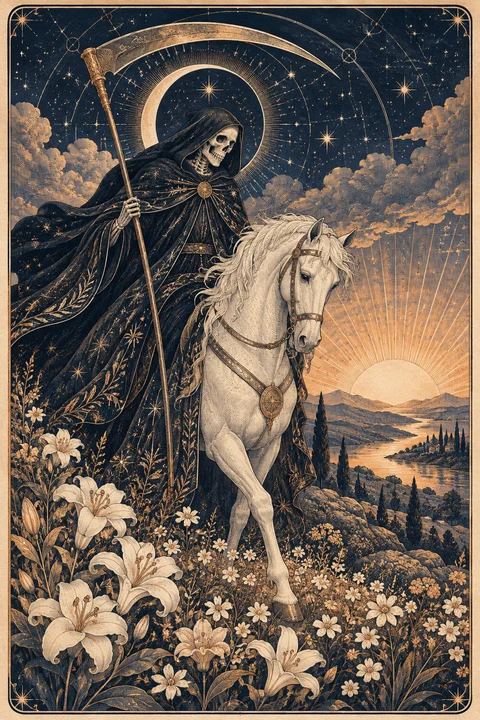
The Death tarot card meaning centers on profound personal transformation, necessary closure, and the clearing away of outdated life patterns rather than physical mortality. In traditional Tarot systems, this card serves as a natural threshold marker indicating that one chapter must close completely so a healthier beginning can take root. Drawing Death simply invites you to release what no longer serves your growth and welcome inevitable evolutionary change.
The Core Symbolism Behind the Rider-Waite-Smith Imagery
In the traditional Rider-Waite-Smith deck illustrated by Pamela Colman Smith, the imagery of card thirteen is rich with nuanced allegorical details that soften its severe reputation. A skeletal figure clad in dark armor sits atop an imposing white horse, carrying a black banner emblazoned with a five-petaled white rose. The skeleton symbolizes that which endures long after ephemeral physical forms decay, while the armor suggests invulnerability to worldly bribes or human negotiations. The white rose represents purification, fresh desires, and the cyclical nature of life. Every element works together to emphasize that mortality here is purely a metaphor for inevitable natural cycles.
Around the feet of the horse stand four human figures representing diverse facets of society: a crowned king, a young child, a maiden, and a robed prelate. The king lies prostrate on the ground, reminding viewers that earthly power and social status cannot exempt anyone from cosmic transitions. The maiden turns away in sorrow, illustrating the very human tendency to grieve necessary change, while the prelate clasps his hands in humble prayer. Most notably, the innocent child looks directly at the skeletal rider without terror, symbolizing how an open mind accepts renewal without fear.
The background landscape offers the most comforting visual evidence regarding the true nature of this archetype. A winding river carries a small boat forward, evoking the ancient mythical waters that transport souls across distinct realms of existence. On the distant horizon, framed between two tall towers, a brilliant golden sun rises over the horizon. Many readers point out that this dawn confirms that endings and beginnings exist simultaneously in the Tarot. Darkness does not have the final say, because the landscape itself proclaims that every twilight inevitably yields to a brand new morning.
Astrological Associations and the Energy of Scorpio
Astrologically, the Death card corresponds directly to Scorpio, the fixed water sign associated with emotional depth, psychological courage, and fundamental metamorphosis. Historically ruled by Mars and connected in modern astrology to Pluto, Scorpio governs the invisible undercurrents of life, including inherited patterns, emotional shedding, and shared resources. Rather than operating like an airy intellectual concept, Scorpio energy works in the subterranean realms of the psyche, compelling individuals to confront what has quietly expired so genuine vitality can return.
Water signs in astrology relate to intuition, memory, and emotional processing, which explains why encountering this archetype can feel intense or destabilizing. When an old emotional pattern or attachment dissolves, you might experience authentic grief, even if you know the transition is healthy. Practitioners describe the Scorpio dynamic through the classical metaphor of the phoenix, a mythical creature that surrenders its worn form to the flames only to emerge revitalized from the ash. Death asks you to respect your emotional process without letting transient discomfort prevent your ongoing growth.
Within the overarching journey of the Major Arcana, Death sits between The Hanged Man and Temperance, creating an intentional narrative sequence. The Hanged Man teaches voluntary surrender, quiet suspension, and seeing the world from an inverted perspective. Once you achieve that quiet acceptance, Death arrives to cut the tether, clearing out the remnants of the past. Immediately following this clearing comes Temperance, bringing balance, emotional healing, and spiritual alchemy. Understanding this context reassures seekers that the clearing stage is merely a bridge to restoration.
Understanding the Death Tarot Card Meaning in Upright Readings
When you encounter the Death tarot card meaning in an upright position, it signals that an era of your life is concluding naturally. This card rarely indicates sudden chaos; instead, it acknowledges a reality that has likely been developing beneath the surface for months. An upright presentation suggests that circumstances have run their course, whether that involves an outgrown ambition, a spent relationship dynamic, or an obsolete self-concept. Embracing the conclusion allows you to conserve your energy for the opportunities currently preparing to emerge.
Consider a situation where someone remains trapped in an unfulfilling corporate career simply because the routine feels familiar. Drawing Death in an upright position does not forecast catastrophe; rather, it suggests that the vitality of that professional chapter has dissipated completely. The card validates the quiet realization that staying longer would only prolong stagnation. Similar dynamics appear when completing an academic program, moving to a new city, or leaving behind behavioral patterns learned in childhood. Upright Death confirms that you have outgrown your current container.
Navigating an upright appearance requires honesty and willing cooperation with time. Divination traditions remind seekers that fighting natural endings usually creates unnecessary distress, much like trying to force fallen autumn leaves back onto tree branches. When you pull this card, take time to reflect on where you feel drained or emotionally numb. Giving yourself permission to say goodbye to expired commitments creates the open, receptive space required to cultivate authentic joy and meaningful future endeavors.
Navigating the Reversed Death Card and Resistance to Change
When Death appears reversed in a spread, practitioners often interpret it as a sign of resistance, emotional stagnation, or fear of stepping into the unknown. The fundamental need for transformation remains present, but the individual may be clinging tightly to the familiar past out of anxiety. Instead of allowing an expired phase to conclude gracefully, a reversed presentation suggests you might be prolonging the inevitable, expending valuable emotional energy to sustain situations that have already lost their spark.
Psychologically, resisting change often stems from a fear of emptiness or a lack of trust in what lies ahead. You might remain in an incompatible partnership or cling to an outdated personal narrative simply because the uncertainty of starting over feels intimidating. In this context, the reversed card acts as a compassionate mirror, highlighting that your reluctance to let go is the genuine source of your discomfort. The stagnation you experience is not caused by the ending itself, but by your insistence on carrying dead weight into tomorrow.
Working constructively with the reversed card involves gentle self-examination rather than self-criticism. Ask yourself what you are terrified of losing if you finally loosen your grip on an old habit, grudge, or obligation. Often, naming your specific fears dispels their power and helps you realize that you possess the resilience to navigate unfamiliar territory. The reversed card gently reminds you that delaying an ending does not prevent it; it merely postpones the renewal waiting on the other side.
Practical Life Applications: Love, Career, and Personal Growth
In relationship readings, the Death card frequently heralds a decisive shift in emotional dynamics rather than a mandatory breakup. For couples experiencing routine conflict, the card often indicates that an unhealthy pattern of communication or an outdated expectation must end so the partnership can evolve into greater maturity. Of course, if a connection has become genuinely toxic or depleted of affection, Death can mark an amicable parting of ways, freeing both individuals to seek genuine fulfillment elsewhere.
Regarding career and vocational pursuits, this archetype points toward structural changes, professional pivots, or the sunsetting of specific projects. You might find that a business strategy that once yielded results is no longer effective, requiring you to sunset old methods in favor of modern approaches. Many readers observe that Death frequently appears when someone is preparing to transition from an employee mindset into entrepreneurship, or when retirement invites an individual to redefine their daily purpose and creative identity.
On an internal, psychological level, the card provides powerful support for breaking destructive habits and outmoded coping mechanisms. If you have struggled with chronic people-pleasing, perfectionism, or unhelpful self-criticism, Death signals that you are ready to dismantle those defensive armor pieces. It encourages you to mourn the circumstances that made those defenses necessary in the past, while consciously choosing healthier habits that reflect who you are today.
Reflective Practices and Integration for Personal Growth
Integrating the energy of this archetype into your reflective routine can turn what once seemed intimidating into an empowering catalyst for personal clarity. A helpful practice involves conducting an honest audit of your daily life, identifying commitments, material possessions, or mental narratives that feel heavy or lifeless. Writing these items down on paper creates tangible distance between your core self and your temporary circumstances, allowing you to evaluate what truly deserves your ongoing attention.
You can deepen this process by meditating on thoughtful questions that honor transitions. Consider asking yourself: What identity am I ready to release so my authentic self can flourish? Where am I resisting closure out of habit rather than genuine desire? What small boundary can I establish this week to protect my peace during a period of transition? Journaling your thoughts without self-censorship often reveals that endings bring relief alongside their natural grief.
Ultimately, integrating the death tarot card meaning into your personal journey transforms apprehension into profound empowerment. Tarot symbolism reminds us that life thrives through rhythm, release, and continuous regeneration rather than permanent preservation. By viewing card thirteen as an ally rather than an omen, you learn to trust the quiet wisdom of closure, knowing that every profound clearing prepares the fertile ground for your next meaningful chapter.
Frequently asked questions
Does the Death card ever indicate literal physical passing in a reading?
In traditional Tarot reading practices, the Death card does not predict physical passing or bodily harm. Tarot functions as a symbolic language for psychological reflection, emotional cycles, and life transitions. Readers interpret the card as an allegory for endings, shedding old identities, and making room for new growth.
Why is the Death card numbered thirteen in the Major Arcana?
Number thirteen historically carries associations with transition, lunar cycles, and the completion of natural orders. Coming directly after The Hanged Man, card thirteen represents the natural consequence of surrender: breaking free from suspended states so the soul can advance toward balance and self-integration in Temperance.
What does it mean if the Death card appears next to The Tower?
When Death appears alongside The Tower, readers typically interpret the combination as an accelerated or dramatic transition. The Tower shatters rigid, false structures suddenly, while Death ensures the outmoded foundation is swept away completely, allowing you to rebuild your life on authentic, sustainable ground.
How does the Death card differ from the Judgement card?
While both cards address significant milestones, Death focuses on closure, natural endings, and clearing out old debris. In contrast, Judgement represents awakening, spiritual reckoning, and answering a higher calling. Death is the necessary release, whereas Judgement is the subsequent resurrection into conscious purpose.