Eight of Swords as Advice Feelings Outcome Tarot Guide
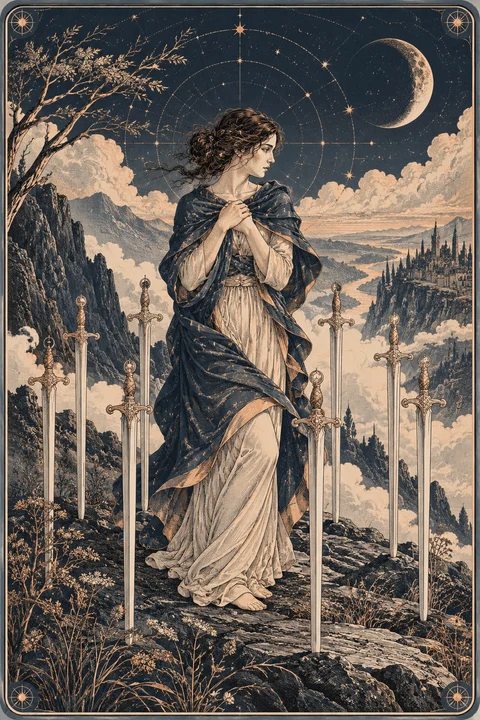
When the Eight of Swords appears in a reading, it points directly toward perceived restrictions, persistent anxiety, and mental narratives that create a sense of helplessness. Whether you interpret the eight of swords as advice feelings outcome card in a spread, this Air-aligned symbol emphasizes that your limitations are largely constructed by your own thoughts. By removing the mental blindfold and stepping beyond familiar fears, you can discover that the path toward clarity remains fully open.
Understanding the Symbolism of the Eight of Swords
In the traditional Rider-Waite-Smith Tarot deck, the Eight of Swords depicts a woman bound with light cords and blindfolded, standing alone in a muddy patch of ground surrounded by eight upright grey blades. While the scene appears frightening at first glance, careful observation reveals that the bindings around her arms are remarkably loose, and the space directly in front of her feet is completely clear of obstacles. Furthermore, no guard watches over her, and the castle behind her sits distant on an elevated cliff, illustrating that her isolation is far more psychological than physical.
As a card belonging to the suit of Swords, this card corresponds to the element of Air, which traditionally governs intellect, communication, logic, and internal truth. When Air energy is balanced, it brings razor-sharp clarity, thoughtful discernment, and objective reason, but when it turns inward or becomes distressed, it breeds destructive overthinking, paranoia, and catastrophic expectations. In numerology, the number eight relates to structure, organization, movement, and karmic momentum, meaning the card represents an intellectual crossroads where your established patterns of thought threaten to immobilize you.
Tarot readers widely view the Eight of Swords as a mirror for cognitive distortions rather than an unchangeable external prison sentence. Practitioners describe this card as an invitation to notice the narratives that you continuously tell yourself about why you cannot leave an unhealthy situation, start a new project, or assert your boundaries. While your feelings of fear and intimidation are valid, the card reminds you that the power to loosen your cords and navigate around the blades has remained in your hands all along.
Reading the Eight of Swords as Advice Feelings Outcome
Determining how to read the eight of swords as advice feelings outcome placement requires paying close attention to where the card lands in your spread and what question you bring to the table. In divination, the position of a card provides the necessary framework, transforming general symbolism into targeted, reflective guidance for your daily life. An intellectual card like this one functions differently when acting as a recommended course of action compared to when it exposes a hidden emotional vulnerability or indicates a probable trajectory.
The surrounding cards in your layout also shape the tone of this card significantly. For example, if the Eight of Swords sits alongside fiery cards like the Eight of Wands or the Knight of Wands, your mental hesitations may be directly clashing with a genuine desire for swift progress. Conversely, if it is framed by watery Cup cards, the mental traps may stem from deeply buried grief, emotional codependency, or a profound dread of romantic rejection. Observing these interactions ensures your interpretation remains holistic and nuanced.
Because modern Tarot emphasizes personal reflection and free will, encountering this card should never be viewed as a negative omen or an inescapable fate. Instead, treat it as a supportive, honest mirror that highlights where you are inadvertently surrendering your personal authority to imagined consequences. By recognizing the card across advice, feelings, and outcome positions, you can pinpoint exactly where mental restructuring is needed to reclaim your confidence and move toward your goals.
Eight of Swords in the Advice Position
When the Eight of Swords falls in the advice position, its primary counsel is to stop validating the mental narrative that you have no options. The card advises you to acknowledge that your perceived dead end is primarily a construct of overthinking, doubt, or excessive caution. Instead of waiting for an external savior or a miraculous change in circumstances, you are urged to take accountability for your current mindset and actively pull off the blindfold that prevents you from seeing realistic alternatives.
Practically speaking, this card recommends breaking complex problems down into manageable components to combat cognitive overload. You can begin by writing down your most prominent worries and testing each one against factual reality, separating verified truths from speculative fears. If you have been avoiding a challenging conversation, postponing an important decision, or hesitating to seek professional counsel, the Eight of Swords advises you to take one small, imperfect action that disrupts the inertia of your current routine.
Additionally, this card can advise you to practice restraint and silence your inner critic rather than rushing into impulsive reactions. Sometimes the swords represent the harsh opinions, expectations, or unsolicited criticisms of other people that you have internalized over time. The advice here is to disconnect from external noise, quiet your racing mind, and trust your inner compass enough to step deliberately out of the mental prison you have unwittingly helped maintain.
Eight of Swords in the Feelings Position
In the feelings position, the Eight of Swords reflects an internal atmosphere marked by vulnerability, intense anxiety, self-doubt, and profound overwhelm. If you are inquiring about your own emotional state, you likely feel trapped in a corner, unable to discern which direction is safe to move. You might feel as though any choice you make will result in conflict, loss, or embarrassment, leading to a state of emotional paralysis where remaining uncomfortable feels safer than risking change.
When reading on how someone else feels toward you or a specific situation, this card suggests they feel heavily restricted, judged, or cornered. They may view the connection through a lens of fear, assuming they lack the freedom to express their true desires without facing harsh criticism or rejection. This person may genuinely care about the dynamic, but their own insecurities and emotional walls are blinding them to the warmth, support, and potential solutions you are extending to them.
Crucially, the feelings depicted by the Eight of Swords often involve an exaggerated sense of isolation, making the querent believe that nobody else understands their dilemma. This emotional state can generate feelings of victimhood or martyrdom, where an individual convinces themselves that suffering in silence is their only remaining alternative. Recognizing this card as a temporary emotional state helps soften its grip, opening the door for compassionate self-forgiveness and gentle honesty.
Eight of Swords in the Outcome Position
When the Eight of Swords emerges as an outcome, it acts as a candid warning that current patterns of avoidance, indecision, and overthinking will produce ongoing stagnation. If you continue to allow fear to dictate your choices, you will likely find yourself in the exact same restricted circumstances weeks or months from now. The outcome does not foretell catastrophe or tragedy; rather, it forecasts a continued state of limbo wherein your talents and ambitions remain constrained by your self-doubt.
In relational readings, this card as an outcome indicates that unresolved misunderstandings, unexpressed grievances, and walking on eggshells will keep the relationship frozen in place. In career or financial inquiries, it suggests that imposter syndrome, fear of failure, or refusal to learn new skills could prevent you from pursuing advantageous opportunities. The outcome highlights that staying passive will inevitably prolong your discomfort, leaving you feeling frustrated by a lack of visible progress.
Fortunately, Tarot outcomes represent the natural culmination of current trajectories rather than unalterable destinies. Because the figure in the Rider-Waite-Smith imagery is not locked inside an iron cell, this outcome card serves as an urgent reminder that you can change the projected result at any moment. By choosing to confront the underlying fears today, you disrupt the momentum of the card and forge a completely different, empowering path forward.
Reversals, Reflection, and Mastering the Eight of Swords
When the Eight of Swords appears reversed, traditional Tarot readers interpret it as a powerful sign of mental liberation, awakening, and the conscious dismantling of limiting beliefs. The blindfold slips off, the bindings drop away, and you begin to recognize options that were previously invisible to your distressed mind. However, in some contexts, a reversed Eight of Swords can indicate extreme self-sabotage, where someone clings stubbornly to their victimhood or completely refuses to acknowledge practical reality despite obvious evidence.
To work constructively with the themes of this card, set aside quiet time for personal reflection and journal on several probing questions. Ask yourself: What narrative am I telling myself that keeps me from making a clear decision? In what areas of my life am I waiting for someone else to rescue me instead of exercising my own agency? Which boundaries or truths am I ignoring because I am afraid of disappointing other people? Answering these prompts honestly can instantly weaken the hold of mental limitations.
Ultimately, understanding the eight of swords as advice feelings outcome allows you to transform an uncomfortable reading into a catalyst for profound personal liberation. The suit of Swords teaches us that our minds can serve as our greatest allies or our harshest captors, depending entirely on how we relate to our thoughts. By acknowledging your fears without letting them steer your actions, you can confidently navigate through the blades of uncertainty and step into authentic freedom.
Frequently asked questions
Is the Eight of Swords a yes or no card?
Traditionally, the Eight of Swords leans toward a no or a strong wait. It indicates that you lack critical information, clarity, or confidence right now. Rushing forward while feeling restricted or blindfolded can lead to complications, so pause, reevaluate your assumptions, and clear your mental space first.
What does the Eight of Swords mean in a love reading?
In love readings, the Eight of Swords suggests feeling suffocated, trapped, or unable to communicate truthfully. It often highlights codependency, fear of vulnerability, or worrying that speaking up will end the relationship. The card invites both partners to dismantle their self-imposed fears and address problems directly.
Does the Eight of Swords indicate someone is manipulating me?
While the card can sometimes reflect feeling cornered by another person, it more commonly symbolizes internal mental manipulation. You may be second-guessing your worth, assuming the worst, or internalizing external opinions. It encourages you to step back objectively and separate external pressure from your own self-doubt.
How can I overcome the energy of the Eight of Swords?
You can overcome this energy by challenging negative thought loops, asking for an objective outside perspective, and taking small, concrete actions. Acknowledge that the bindings are loose and focus solely on what is within your direct control, allowing practical steps to dissolve your perceived paralysis.