Ten of Swords as Advice Feelings Outcome Meaning
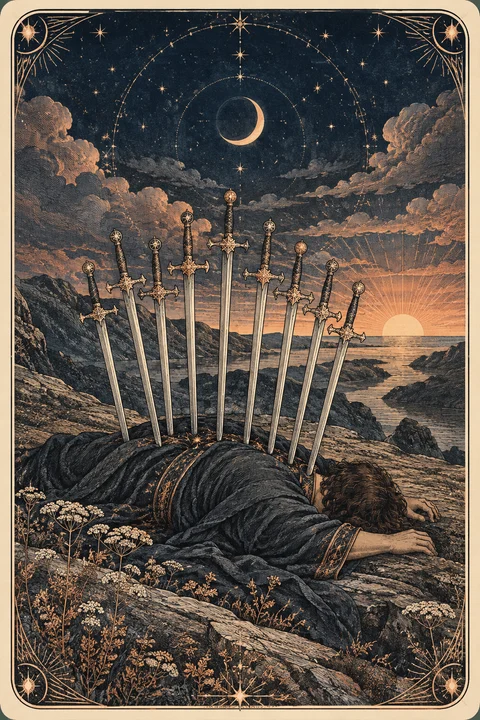
When interpreting the Ten of Swords as advice feelings outcome in a Tarot reading, this card signals an absolute ending, the release of mental struggle, and the arrival of a turning point. Traditionally associated with the suit of Swords and the element of Air, it marks the definitive conclusion of a painful intellectual cycle or conflict. Rather than indicating defeat without hope, its presence affirms that rock bottom has passed and that the worst of the situation is officially behind you.
Understanding the Ten of Swords in the Suit of Swords
In the Rider-Waite-Smith tradition, the Ten of Swords represents the culmination of the suit of Swords, which corresponds to the element of Air. Air governs the realm of thought, belief systems, communication, truth, and psychological conflict. Numbers reaching ten always signify the final manifestation of a suit, where an energy has played out to its fullest logical expression. Consequently, this card illustrates what happens when an intellectual conflict, worry, or interpersonal friction reaches its natural terminus.
The imagery on the card is deliberately dramatic, featuring a fallen figure pinned to the earth by ten swords under a pitch-black sky. While this visual appears bleak at first glance, Tarot symbolism uses striking hyperbole to convey psychological reality. The ten swords represent overkill, demonstrating that no further analytical effort, argumentation, or defense is possible. Crucially, along the horizon, the golden light of dawn is breaking over a calm body of water, reminding the reader that every ending carries the seed of renewal.
Many readers associate this card with dramatic mental patterns, cognitive burnout, and the exhaustion that follows prolonged resistance. When you examine the card closely, the calm water reflects emotional stillness after a storm, while the rising sun indicates an inevitable transition into a new cycle. By honoring the traditional meaning of Air, the card encourages you to examine how your assumptions, beliefs, or communication patterns contributed to reaching this final boundary.
Core Symbolism and Meaning in Everyday Readings
At its core, the Ten of Swords addresses the concept of rock bottom, but with an emphasis on liberation. In everyday inquiries, the card rarely points to literal catastrophe; instead, it mirrors the dramatic weight our minds place on circumstances. It frequently indicates an undeniable realization that a project, dynamic, or mindset has exhausted its utility. When this card appears, practitioners describe it as a cosmic tap on the shoulder confirming that the struggle has concluded.
A critical nuance of the Rider-Waite-Smith depiction is the presence of overkill, suggesting that our inner narratives can amplify distress beyond the reality of the situation. Are you clinging to an argument that you already lost weeks ago? Are you keeping yourself tied to a role that drains your creative energy? The card reminds us that when things cannot get any worse, they can only improve. It represents the boundary where conscious surrender becomes the most empowering choice available.
Additionally, the card carries themes of betrayal, sudden disappointment, or harsh awakenings that shatter illusions. Even when the truth feels sharp, the clarity it brings is ultimately merciful because it dismantles false hope. By forcing you to face the reality of a situation without sugarcoating, the Ten of Swords clears away deception and leaves you standing on solid, honest ground.
Ten of Swords as Advice: Surrender the Struggle
When the Ten of Swords lands in the advice position of a spread, its guidance is unmistakable: stop fighting an unwinnable battle and accept the ending. Air-based energy often tempts people to overthink, negotiate, or formulate endless contingency plans. In this placement, the card advises you to lay down your mental weapons, cease defending your position, and acknowledge that the matter has concluded. Continuing to struggle only drains your remaining resources and prolongs your discomfort.
Practitioners frequently interpret this card as a call for radical acceptance and graceful surrender. If a creative project has stalled completely, the wisest step is to archive it rather than pour endless revisions into a broken concept. If a workplace project is defunct, step aside and let the process run its course. The advice here is not passive helplessness, but the active, mature decision to stop investing attention into a dynamic that yields nothing in return.
Consider reflecting on where you are resisting an inevitable ending out of pride or habit. Ask yourself what burden you would drop if you accepted defeat in this specific arena. By embracing the advice of the Ten of Swords, you make a conscious choice to close the chapter completely, thereby allowing the healing dawn on the horizon to illuminate your next chapter.
Ten of Swords as Feelings: Processing Emotional Finality
In the feelings position, the Ten of Swords reflects an experience of intense psychological fatigue, grief, or complete disillusionment. Someone experiencing this energy may feel emotionally drained, deeply let down, or convinced that they have been blindsided by circumstances. It represents the specific emotional state that occurs when the realization dawns that a dynamic cannot be salvaged, leaving a person feeling utterly spent.
This placement often highlights feelings of betrayal or dramatic disappointment in another person. The querent or the person in question might feel as though they were stabbed in the back or unfairly blamed for shared difficulties. However, there is also an undercurrent of relief present in these emotions. Even though the conclusion hurts, the ambiguity is finally gone, and the mind is no longer suspended in anxious anticipation of what might go wrong.
When reading feelings, this card asks you to validate your emotional experience without magnifying the victimhood narrative. It is natural to feel drained after navigating prolonged conflict or emotional tension. Recognizing these heavy feelings allows you to honor the weight of what has concluded, process the sadness thoroughly, and gradually open yourself to quiet acceptance.
Ten of Swords as Outcome: Reaching the Final Conclusion
Appearing in the outcome position, the Ten of Swords indicates a definitive, non-negotiable ending to the question at hand. Whatever matter prompted the reading will reach a total conclusion, leaving no room for ambivalence or half-measures. While this may sound intimidating, it is often a constructive outcome because it breaks cycles of repetitive indecision, lingering disputes, and false starts that have held you stagnant.
For career inquiries, this outcome might signal the end of a job, the shelving of an initiative, or the complete exhaustion of an unsustainable work pace. In relationship contexts, it frequently points to a permanent parting of ways, a clean breakup, or the total collapse of an unhealthy communication pattern. Because the outcome is final, it guarantees that you will not remain trapped in the same unproductive loop indefinitely.
The outcome of the Ten of Swords also reminds us that endings are structural requirements for new growth. Once the structure collapses, the mental space previously occupied by worry is suddenly liberated. The horizon depicted on the card affirms that tomorrow brings fresh possibilities, free from the entanglements that previously weighed you down.
Navigating the Ten of Swords as Advice Feelings Outcome Across Contexts
Synthesizing the card across different spreads requires paying close attention to neighboring cards and the overall inquiry. When evaluating the Ten of Swords as advice feelings outcome in a love reading, the focus centers on ending codependency, accepting that a romantic dynamic has finished, or letting go of an obsessive fixation. It urges honest closure so that genuine personal growth can take place in future relationships.
In career and financial spreads, this card speaks to eliminating sunk-cost fallacies. Many professionals continue funneling time and resources into dead-end ventures simply because they have already invested so heavily. When this card appears, it tells you that the loss has already occurred, and the smartest strategy is to cut ties immediately rather than prolonging financial or mental strain.
Step-by-step interpretation begins by identifying where mental exhaustion is most prevalent in your daily life. Next, examine whether you are treating an ending as a punishment or as an opportunity for profound release. Finally, redirect your attention toward the calm water and rising sun in the background of the image, shifting your mindset from past defeat to prospective renewal.
Embracing the Dawn Beyond the Painful Climax
The lasting wisdom of the Ten of Swords lies in its promise of liberation through absolute finality. While earlier Swords cards, such as the Three or the Nine, deal with acute sorrow and middle-of-the-night worry, the Ten resolves the tension completely. There are no more swords left in the suit to drop, which means the trial has reached its limit and the suffering cannot escalate further.
By viewing this archetype as a neutral map of psychological cycles, you can reframe your experiences with compassion and self-awareness. Endings are not personal failures; they are the natural closing notes of lived experience. When you stop fighting the reality of a painful chapter, you conserve your strength for the sunrise that quietly follows.
As you conclude your reading, remember that every card in Tarot operates in service of your evolving story. The Ten of Swords invites you to exhale, accept the truth of what has passed, and step forward into the clean air of an unburdened horizon.
Frequently asked questions
Is the Ten of Swords always a negative omen?
No, the Ten of Swords is not inherently a negative omen. While its imagery is intense, readers view it as a card of profound release, closure, and relief. It confirms that the worst phase of a difficult challenge has concluded, clearing away lingering stress and offering a fresh start.
What should I do when the Ten of Swords appears as advice?
When drawn as advice, the Ten of Swords encourages you to cease fighting an unwinnable battle and accept an ending. Release mental resistance, let go of pride, and stop trying to revive a situation that has run its course. Embracing closure allows you to protect your energy.
How does the Ten of Swords differ from the Death card?
While both cards indicate endings, Death is a Major Arcana card representing broad, natural transformation, rebirth, and evolutionary cycles. In contrast, the Ten of Swords is a Minor Arcana card focused specifically on the intellect, cognitive exhaustion, communication breakdowns, and the dramatic conclusion of mental struggles.
Does the Ten of Swords as feelings mean someone hates me?
Not necessarily. In the feelings position, the card typically reflects profound exhaustion, feelings of betrayal, or the sharp realization that a dynamic cannot continue. Rather than pure malice, it often reveals that someone feels drained, hurt, or resigned to the fact that the connection has broken down.