Ten of Swords Career Meaning: Work and Money Guide
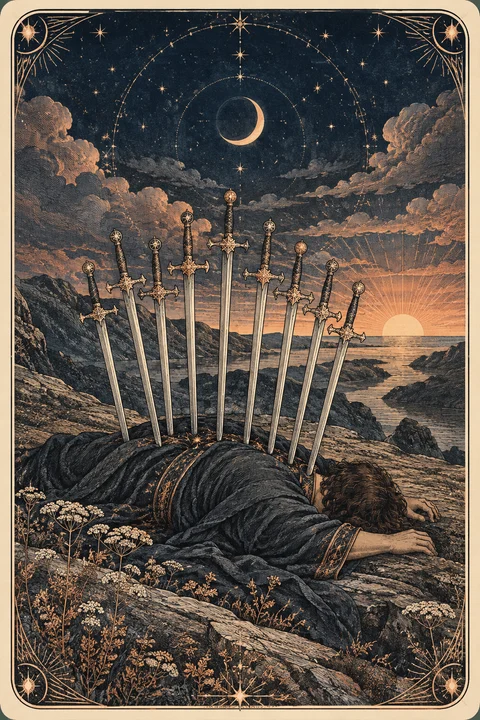
The ten of swords career meaning points to the definite conclusion of a difficult professional chapter, severe burnout, or an unavoidable job transition. While this card can look alarming at first glance, it traditionally signals rock bottom, meaning the worst of the professional struggle has already passed. Rather than an ongoing defeat, this card marks a clear ending that finally clears the space for recovery, mental clarity, and genuine renewal.
Understanding the Symbolism of the Ten of Swords
In the traditional Rider-Waite-Smith deck, the Ten of Swords presents one of the most striking images in the Minor Arcana. A figure lies facedown on the ground, blanketed by a red cloth, with ten golden swords pierced along their spine. Beyond this somber foreground, however, the dark clouds are parting across a calm body of water to reveal a golden dawn on the distant horizon. Divination practitioners describe this imagery as a dramatic metaphor for absolute finality. The suit of Swords belongs to the element of Air, which rules the intellect, communication, truth, and mental conflict. Therefore, this card rarely describes physical catastrophe. Instead, it mirrors mental exhaustion, sudden realizations, and the collapse of belief systems or work structures that could no longer stand.
The presence of all ten swords emphasizes completion. In numerology, the number ten represents the closing of a cycle and the inevitable transition into a fresh start. Because every sword has already landed, the struggle depicted is entirely over. The person in the card is no longer fighting or negotiating. When this card appears in a reading, it suggests that you have reached the absolute limit of what your mind or nervous system can endure in your current setting. Understanding this card requires shifting your focus from the dramatic loss to the golden dawn breaking in the background. The pain of the ending is real, but the threat of ongoing harm has ceased because the cycle is definitively finished.
Upright Ten of Swords Career Meaning
When you encounter the upright ten of swords career meaning in a professional spread, it often marks an undeniable ending. This may arrive as a company layoff, the termination of a contract, the cancellation of a long-term project, or a point of absolute career burnout where you simply cannot continue on your present course. Many readers view this card as validation that a professional situation has run its course. If you have spent months trying to salvage a deteriorating work environment, this card serves as a frank mirror showing that additional effort will not revive what is already broken. Acceptance is the central theme here, asking you to stop bargaining with circumstances that are clearly over.
Beyond organizational shifts, this card frequently highlights workplace politics, betrayal, or feeling undermined by colleagues or leadership. Because the Swords suit governs communication, the difficulty often stems from broken trust, gossip, harsh evaluations, or severed agreements. Experiencing this kind of rupture is profoundly disorienting, yet the card offers reassurance through finality. You no longer need to walk on eggshells, anticipate the other shoe dropping, or carry unrealistic expectations. The truth of the situation is fully out in the open. While mourning the loss of a role or an ambition is healthy, you can take comfort knowing that the most taxing phase of the ordeal has finished.
From an opportunity perspective, the upright Ten of Swords provides the gift of closure. When a door slams completely shut, it eliminates the agonizing ambiguity that keeps people trapped in harmful jobs. You are finally freed from lingering obligations that drained your energy. Use this time to rest your mind, recalibrate your resume, and assess the lessons learned from the experience. Reflect on how your boundaries functioned and what you require from your next workplace culture. The card urges you to step away from the battlefield entirely, allow yourself space to decompress, and trust that a more supportive professional foundation can now be built.
Financial Meaning of the Upright Ten of Swords
In matters of personal finance, the upright Ten of Swords signifies coming face-to-face with an uncomfortable fiscal reality. This card often surfaces when an unexpected cost drains your reserves, an investment plan fails, or a budget completely breaks down. It represents hitting financial rock bottom, where avoidance is no longer an option. Tarot serves as a tool for personal reflection rather than financial advice, and in this context, the card invites honest inventory. The swords piercing the figure symbolize facing the unvarnished facts of your balance sheet without self-deception or sugarcoating. Admitting the true scope of a monetary setback is the necessary first step toward resolving it.
This card also warns against making desperate or impulsive financial moves in a panic. When individuals feel backed into a corner, they are often tempted to take high-risk gambles or sign unfavorable agreements just to relieve temporary pressure. The Ten of Swords advises the opposite approach: surrender the illusion of a quick fix and accept the current baseline. Once you acknowledge exactly where your finances stand, the feeling of chronic dread begins to lift. You can begin organizing debts, speaking with reputable non-profit credit counselors, or trimming non-essential expenses. The worst financial surprises are already behind you, creating a clean slate for disciplined rebuilding.
Reversed Ten of Swords in Work and Money
When the Ten of Swords appears reversed in a career reading, its interpretation generally splits into two distinct paths depending on your recent circumstances. Traditionally, the most common interpretation is gradual recovery and survival. If you have recently weathered a painful job loss, severe burnout, or a corporate restructuring, the reversal indicates that you are pulling the swords out one by one. You are beginning to regain your mental stamina, clarify your ambitions, and realize that your career identity survived the crisis. The dark clouds are lifting, and you are starting to look toward prospective employers or projects with renewed optimism.
Alternatively, practitioners describe the reversed Ten of Swords as a caution against clinging to victimhood or refusing to let a dead situation go. In this expression, a person might remain fixated on past workplace unfairness, endlessly replaying grievances about a previous boss or an unfair severance. Reliving past injuries prevents you from moving forward into promising opportunities. It can also point to resisting an inevitable ending, such as staying in a position that causes severe distress simply because the idea of quitting feels like failure. The card asks whether you are prolonging your own suffering by holding onto circumstances that have already expired.
Financially, the reversed card indicates a slow, steady climb out of hardship. You may be starting to pay down liabilities, finding modest supplementary income, or finally recovering from an expensive life event. The critical lesson here is patience. Rebuilding your financial standing after a setback takes consistent, quiet dedication rather than grand gestures. Acknowledge the resilience you showed in making it through the tightest moments, and maintain simple, sensible money habits as your security gradually returns.
Navigating Burnout and Career Transitions
Burnout is perhaps the most frequent modern manifestation of the Ten of Swords. In our fast-paced work culture, mental exhaustion often goes unacknowledged until the body and mind stage a complete shutdown. Because Swords represent mental faculties, this card reminds us that the human intellect cannot operate under chronic strain indefinitely. If you have been overworking, ignoring rest, and carrying responsibilities far beyond your capacity, the card arrives as an urgent intervention. It shows that continuing down this path will lead to total depletion, making radical self-care and firm work-life boundaries an essential priority rather than a luxury.
If you are currently undergoing an involuntary career transition, such as being laid off, recognize that feelings of grief and anger are entirely natural parts of the process. Healthy grieving applies to professional identities just as it does to other life chapters. Give yourself permission to mourn the loss of your routine, your work community, or your anticipated trajectory. At the same time, keep the card's sunrise in your awareness. Many people discover in hindsight that their most distressing professional endings forced them into industries, roles, or creative ventures that suited them infinitely better than the jobs they lost.
Practical Reflections for the Ten of Swords Career Meaning
To translate the insights of the Ten of Swords into practical daily actions, start by conducting a thorough audit of your current professional commitments. Identify the responsibilities, projects, or toxic communication habits that feel like additional swords draining your vitality. What can you delegate, delay, or decline entirely? Honoring the message of this card means deliberately laying down your mental burdens instead of trying to carry them across an imaginary finish line. Establishing clear boundaries around your working hours and emotional investment is critical for long-term well-being.
Take time to journal on candid, self-reflective questions: Where in my professional life am I resisting an ending that has already occurred? In what ways have I allowed fear of the unknown to keep me tethered to an unhealthy workplace? How can I practice compassion toward myself as I navigate this career transition? What lessons from this painful situation will protect my peace in my next role? Engaging with these prompts helps shift your perspective from passive victim of circumstance to an active author of your upcoming professional chapter.
Frequently asked questions
Does the Ten of Swords mean I will be fired from my job?
Not necessarily. While the card indicates a definitive ending, that ending could be the finish of a demanding project, leaving a toxic team by choice, or reaching the end of your tolerance for burnout. Divination cards reflect current energies and possibilities rather than guaranteed events. Use the card as a prompt to evaluate job security, refresh your professional materials, and set healthy boundaries.
What should I do if the Ten of Swords appears in a financial spread?
Treat the card as a call for complete transparency and grounding. Avoid high-risk investments or speculative schemes aimed at quick recovery. Instead, review your balance sheet carefully, cut unnecessary spending, and consult a qualified, independent financial professional if debt feels unmanageable. The card indicates that the worst financial surprises have passed, so focus on steady, step-by-step rebuilding.
Is the Ten of Swords always a negative card for career questions?
While the card depicts a difficult moment, many readers consider it a card of immense relief. Its primary message is that your suffering has peaked and cannot get any worse. The ambiguity, anxiety, and dread of an impending crisis are over. The card confirms that you have reached rock bottom, which means your next phase brings recovery, dawn, and fresh opportunities.
How does the Ten of Swords differ from the Tower in a career reading?
The Tower represents sudden, unforeseen external disruption that shatters existing foundations, like an unexpected corporate buyout. The Ten of Swords is usually the culmination of a long, painful mental process or ongoing conflict that you likely saw developing. Swords highlight mental exhaustion, betrayal, and finality, whereas The Tower emphasizes rapid, chaotic restructuring.