Five of Swords Love Meaning: Upright and Reversed Guide
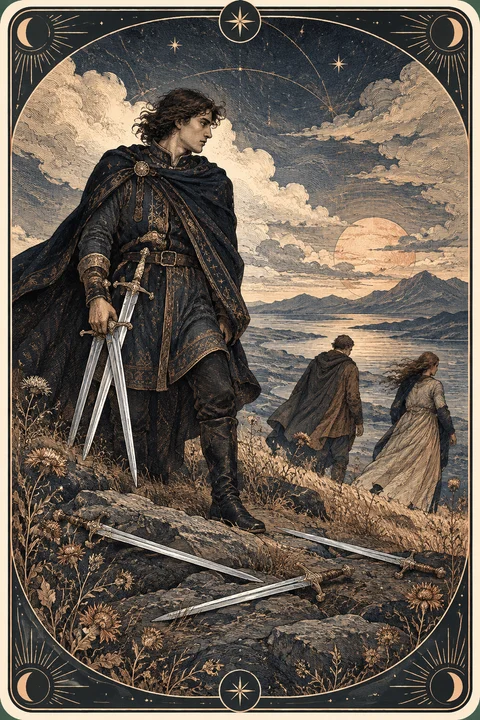
In relationship readings, the five of swords love meaning centers on conflict, wounded pride, and the emotional cost of needing to win every disagreement. This card often reflects hostile arguments, lingering resentment, or an unhealthy dynamic where one person prioritizes victory over connection. When it appears, it invites you to reflect on whether defending your personal ego is actively undermining the mutual trust you hope to build.
Understanding the Symbolism of the Five of Swords
In the Rider-Waite-Smith tradition, the Five of Swords illustrates a smug figure gathering dropped blades while two defeated individuals walk away toward choppy water and jagged clouds. As a card belonging to the suit of Swords, it is governed by the element of Air, which rules intellect, communication, truth, and mental clarity. Fives throughout Tarot represent disruption, challenge, and instigating change, which often feels destabilizing when it touches our emotional lives.
The imagery reveals the hollow nature of conquest within a relationship. The central figure has technically won the duel, yet they stand entirely alone against a turbulent sky. Tarot readers frequently point out that the card portrays a pyrrhic victory, meaning the cost of winning exceeds any tangible benefit gained. The two figures in the background convey grief and dejection, reminding us that someone always pays the price when pride governs human interaction.
When this card appears in a love spread, it rarely points to lighthearted misunderstanding. Instead, it mirrors sharper tensions where one or both people treat the relationship as an arena rather than a sanctuary. By viewing this card through psychological reflection, you can identify where cognitive rigidness and defensive instincts might be overriding compassion and compromise.
Upright Five of Swords Love Meaning for Relationships
When you draw the upright five of swords love meaning in an ongoing relationship, it highlights an environment marked by contention and power imbalances. Disagreements in this state are seldom about solving underlying issues; rather, they become battlegrounds for proving who is right and who is wrong. You or your partner may be keeping score of historical slights, using harsh language, or withholding warmth to punish the other.
This dynamic creates emotional distance because neither person feels safe revealing vulnerability. When pride runs the show, empathy leaves the room, replaced by sarcastic barbs, passive aggression, or calculated emotional withdrawals. Many practitioners observe that this card exposes a pattern of subtle manipulation, such as shifting blame onto the other person to avoid accountability. The card does not automatically mean a breakup, but it starkly warns that continuing down this path will erode the partnership.
To work constructively with this card, you must take an honest inventory of how arguments unfold between you. Are you listening to understand your partner, or are you simply waiting for your turn to counterattack? Acknowledging that victory achieved through humiliation is actually a shared loss can help you break the cycle of recurring hostility.
What the Five of Swords Means for Singles
For singles, drawing this card suggests that your current approach to dating may be influenced by lingering defensiveness or battle fatigue. If you recently navigated a painful separation or betrayal, you might still carry your emotional armor into new interactions. Expecting disappointment or deception from potential partners often leads to self-fulfilling prophecies, causing you to reject people preemptively before they have an opportunity to hurt you.
The card can also indicate a competitive or distrustful energy in your recent dating experiences. You might find yourself drawn to emotionally unavailable individuals who treat romance like a game of cat and mouse, where attention must be conquered rather than shared freely. Alternatively, you might be testing suitors with unfair obstacles to see if they will fail, mistaking skepticism for wise discernment.
Reflecting on the Five of Swords encourages you to disarm before stepping into modern romance. True connection requires a degree of risk and emotional openness that armor simply cannot accommodate. Taking time to process past grievances allows you to date with authentic confidence rather than combative self-preservation.
The Five of Swords as Feelings and Personality Traits
When interpreted as feelings, the Five of Swords describes a complex blend of bitterness, defensiveness, and emotional exhaustion. If representing your own feelings, you may feel misunderstood, cornered, or resentful of carrying relational burdens alone. If it reflects what someone else feels toward you, they may perceive you as combative or unyielding, leading them to close off their emotional channels out of self-protection.
As a personality descriptor, this card embodies an individual with a razor-sharp intellect who struggles with humility. This person often excels at verbal sparring and rational argumentation, but they frequently lack the emotional gentleness required for intimate partnerships. They may take secret satisfaction in being right, hold onto grudges long past their expiration date, and find it deeply uncomfortable to offer an unreserved apology.
Understanding this archetype helps you determine whether you are dealing with an uncompromising partner or exhibiting these tendencies yourself. While mental sharpness and clear boundaries are admirable qualities, weaponizing intellect within romantic relationships alienates the very people you wish to hold close.
Reversed Five of Swords in Love Readings
When the card appears upside down, the energy often signals a shift away from active combat toward resolution, exhaustion, or necessary endings. The reversed Five of Swords frequently represents laying down your arms after a protracted period of arguing. Both individuals may finally realize that perpetual hostility is unsustainable, paving the way for honest dialogue, heartfelt apologies, and genuine reconciliation.
However, readers also note that the reversed position can occasionally manifest as an uneasy silence or lingering resentment. If a conflict was swept under the rug rather than genuinely resolved, the swords may be dropped, but the underlying bitterness remains intact. It is vital to ensure that a truce is grounded in mutual respect rather than defeated apathy, where one person simply surrenders to keep a fragile peace.
In some readings, this reversal indicates walking away from an undeniably toxic situation. You may finally decide that your peace of mind is worth more than having the last word. Recognizing when an environment is irredeemably adversarial allows you to step back gracefully and direct your emotional resources toward your own healing.
Love Advice and Questions for Personal Reflection
As practical relationship advice, the Five of Swords urges you to choose harmony over self-righteousness. When a disagreement begins to heat up, consciously pause and ask yourself if prevailing in the debate is worth injuring your partner's self-esteem. Step away from toxic communication habits like contempt or mockery, and practice responding with curiosity rather than counterclaims.
Consider establishing healthy conversational boundaries during heated moments. Agreeing to take a twenty-minute pause when emotions escalate prevents words from becoming weapons you cannot retract. Shifting your internal paradigm from 'me versus you' to 'us versus the issue' immediately transforms the emotional climate of your partnership.
Take a moment to contemplate several focused questions during your personal journaling. Where in my relationship am I fighting to be right instead of fighting for connection? In what ways might past hurts be making me defensive in present conversations? How can I communicate my genuine boundaries without resorting to cruelty or emotional withdrawal?
Healing and Transforming the Five of Swords Love Meaning
Integrating the five of swords love meaning into your life is ultimately an exercise in emotional maturity and intentional repair. Conflict is an inevitable component of any long-term union, but cruelty and disrespect never have to be. By recognizing the destructive temptation of pride, you can pivot away from petty battles and toward authentic relational growth.
Rebuilding after a period of discord demands patience and deliberate accountability. True strength is not demonstrated by proving your partner wrong or leaving them with nothing to say; it is demonstrated by lowering your defenses first and opening the floor for restorative honesty. When both partners commit to emotional safety, the swords that once divided them can finally be laid aside.
Whether you are single, recovering from a split, or working to fortify an existing union, view this card as a compassionate mirror. It reveals where mental rigidness has trapped you in conflict and offers a pathway forward. By prioritizing shared understanding over personal victory, you cultivate the safety necessary for love to flourish.
Frequently asked questions
Does the Five of Swords always mean a breakup is coming?
No, the card does not guarantee a breakup. It reflects an atmosphere of intense friction, pride, or poor communication that requires attention. While it can suggest an eventual separation if hostility remains unchecked, it frequently functions as an urgent wake-up call to change how you and your partner handle disagreements.
What should I do if the Five of Swords represents my partner?
If this card represents your partner, it indicates they are currently defensive, guarded, or overly focused on winning arguments. Avoid meeting hostility with equal hostility, as that fuels the cycle. State your feelings clearly, establish firm boundaries against verbal disrespect, and suggest discussing difficult issues only when emotions are calm.
Can the Five of Swords signify infidelity or betrayal in love?
Traditionally, the Five of Swords can suggest underhanded behavior, deception, or broken trust, particularly when accompanied by cards like the Seven of Swords or Three of Swords. However, it more commonly points to emotional betrayal, such as gossip, belittling comments, or breaking emotional safety rather than physical infidelity.
How does the Five of Swords differ from the Three of Swords in love?
The Three of Swords represents acute emotional sorrow, heartbreak, and grief, often stemming from sudden clarity or loss. The Five of Swords, by contrast, is driven by the ego and intellect, focusing on active conflict, malicious pride, power struggles, and the bitter aftermath of interpersonal friction.