Death Reversed Meaning: Guide to Major Arcana 13
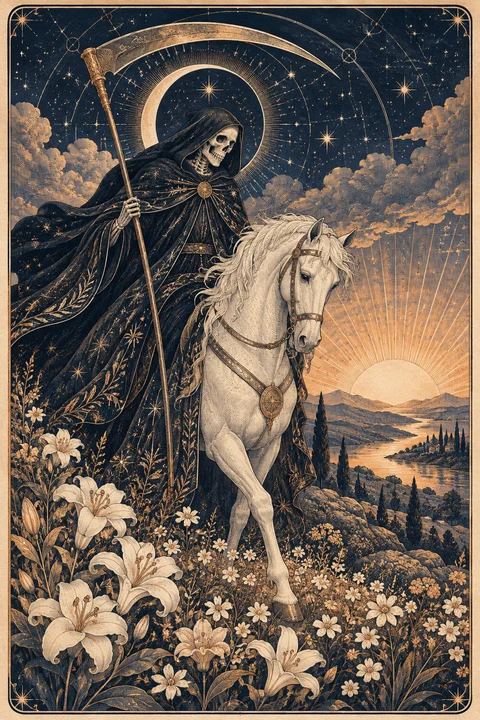
The Death reversed meaning traditionally points to resistance to inevitable change, delayed transitions, or an internal transformation that has not yet manifested in the physical world. While upright Death signals natural endings and necessary clearing, the reversed card suggests you may be clinging to outdated habits, relationships, or beliefs out of fear of the unknown. When this card appears inverted, it invites you to identify what you are struggling to release so that genuine renewal can finally take root.
The Core Symbolism of Major Arcana 13
In the Rider-Waite-Smith tradition, Death carries the number thirteen in the Major Arcana sequence and corresponds astrologically to the water sign Scorpio. Pamela Colman Smith illustrated this card not as an omen of physical demise, but as an archetypal force of profound clearing and renewal. The skeletal knight rides a pale horse across a field where kings, bishops, and maidens fall equally, demonstrating that cyclical transition spares no one. In the knight's hand rests a black banner emblazoned with the mystic white rose of purification and immortality.
The background scenery holds equal weight in understanding the card's philosophical foundation. Behind the grim rider flows a winding river, representing the continuous current of life, while in the far distance, the sun rises between two stone towers. This rising dawn confirms that every conclusion contains the seed of a fresh beginning. When the card stands upright, this transition unfolds with natural, sweeping certainty, sweeping away stagnant structures to create fertile ground for the soul's next developmental phase.
Astrologically, Scorpio governs deep emotional undercurrents, shared bonds, vulnerability, and regeneration. Death channels this fixed water energy by addressing the attachments that bind the spirit. Rather than predicting literal catastrophe, the card mirrors psychological transitions, such as graduating from a career stage, leaving behind an outgrown identity, or resolving an emotional era. Recognizing this foundation makes interpreting the card inverted far less intimidating and far more productive.
Understanding the Death Reversed Meaning
When inverted, the death reversed meaning centers on arrested development, emotional hesitation, and holding fast to circumstances that have run their natural course. Instead of allowing old structures to fall away peacefully, a person encountering this card may be actively fighting the transition. You might recognize that a job, friendship, or personal belief system no longer serves your well-being, yet you remain rooted in place because the familiar feels safer than an uncertain future.
Practitioners also observe that the reversed position can signify an ending that drags out unnecessarily. When someone postpones a difficult conversation or ignores obvious warning signs, the inevitable conclusion does not disappear; rather, it becomes prolonged and draining. In this light, the reversed card acts as a compassionate mirror, asking you why you are expending precious energy to prop up a situation that has already run out of vitality.
Alternatively, the card can point to the quiet aftermath of a major disruption. If you recently experienced a significant loss or lifestyle overhaul, the reversal may indicate that you are still integrating the emotional shock. Healing is rarely a linear journey, and this card can gently remind you that moving forward requires honoring your grief before you can fully embrace the rising sun waiting on your horizon.
Four Reading Frameworks: Blocked, Internal, Excess, and Lack
Modern readers frequently apply specific interpretive lenses to reversed cards to gain deeper nuance. Viewed as blocked energy, Death reversed suggests external constraints or acute personal fear preventing a clean break. You might desire a fresh chapter in life, but financial logistics, familial expectations, or self-doubt currently prevent you from walking through the open door. The energetic current of change is dammed up, causing frustration and lingering emotional fatigue.
Viewed as an internal experience, the reversal shifts the entire archetype inward. Here, the physical circumstances of your life may look stable from the outside, but your inner world is experiencing a quiet metamorphosis. You may be reevaluating your core values, discarding spiritual dogmas, or outgrowing longstanding coping mechanisms without making dramatic external announcements. This private shedding of skin is profound, necessary work that needs time to stabilize before surfacing publicly.
Through the lens of excess, the card warns against an obsessive fear of mortality, endings, or change itself, leading to hypervigilance and rigid control. Conversely, interpreted through lack, the reversal indicates an unwillingness to let anything end at all, resulting in chronic clutter in your calendar, your home, or your emotional life. Both extremes disrupt the rhythmic balance between receiving new experiences and releasing what has expired.
How Tarot Schools Interpret the Reversal
Interpretations of inverted cards vary noticeably across different historical and modern schools of Tarot. In older French and Italian traditions, such as the Tarot of Marseilles, many readers did not invert cards at all, relying instead on adjacent cards to determine whether the energy flowed beneficially or uncomfortably. When early Continental cartomancers did examine reversals, they often viewed Major Arcana 13 simply as inertia, chronic illness of projects, or stubborn immobility.
The Hermetic Order of the Golden Dawn, which heavily influenced Arthur Edward Waite, viewed reversals through esoteric astrological attributions. Because Death corresponds to Scorpio and the Hebrew letter Nun, Golden Dawn practitioners often associated the inverted card with stagnant water, corrupted regeneration, or spiritual lethargy. Waite himself noted that the reversal could mean sleep, petrifaction, or hope deferred, underscoring the concept of frozen potential rather than active catastrophe.
Contemporary psychological Tarot readers, drawing on Carl Jung's concepts of the shadow and individuation, emphasize personal agency when discussing this card. In psychological readings, Death reversed represents the ego's stubborn resistance to the unconscious demand for personal growth. Rather than viewing the card as an external decree of fate, modern practitioners encourage seekers to explore their internal defense mechanisms and unconscious attachments to past identities.
Death Reversed in Practical Life Readings
In relationship inquiries, the inverted card frequently signals a partnership that has settled into emotional stagnation or a lingering attachment to a past romance. One or both partners may realize the dynamic has expired, yet neither wants to confront the grief of parting. If the relationship is fundamentally healthy, the card suggests that an outdated dynamic—such as an old communication habit or power imbalance—needs to be eliminated before the couple can experience true emotional intimacy again.
When consulting the deck regarding career or financial matters, the reversal highlights staying in an unfulfilling role out of fear of professional vulnerability. You might cling to a secure paycheck or a prestigious title even though the work no longer offers creative growth or purpose. The card advises you to update your skills, acknowledge where you feel uninspired, and construct an orderly exit strategy rather than waiting for external circumstances to force your hand.
For personal well-being and creative pursuits, this card suggests artistic blocks born from perfectionism or fear of criticism. Writers, artists, and innovators often pull this card when they refuse to abandon an initial draft that is clearly not working. Giving yourself permission to discard flawed drafts or outdated self-concepts is often the exact catalyst required to unleash genuine creative breakthroughs and emotional vitality.
Reading the Card in Context and Reflection
A Tarot card never speaks in isolation, and the cards surrounding Death reversed help clarify the root cause of your hesitation. If the card appears alongside The Tower, an external disruption is likely breaking through your defenses despite your best efforts to maintain the status quo. If paired with the Two of Swords, the delay stems from intentional indecision and avoidance of a painful truth.
Conversely, when combined with hopeful cards like The Fool or The Star, the reversal signals that you are standing on the very brink of recovery and renewal. The hardest part of the internal transition has concluded, and you need only take the courageous initial step into your next chapter. Examining whether the adjacent cards are active Wands, mental Swords, emotional Cups, or grounded Pentacles clarifies where your energy is currently trapped.
To work constructively with the death reversed meaning, consider journaling on these guiding questions: What situation am I attempting to preserve even though its vitality has faded? What specific vulnerability am I avoiding by staying within my comfort zone? By answering these inquiries honestly, you transform resistance into conscious understanding, allowing the regenerative power of Major Arcana 13 to guide you toward meaningful renewal.
Frequently asked questions
Does Death reversed mean physical death?
No, Tarot cards rely on rich psychological and spiritual metaphors rather than literal predictions. In standard Tarot tradition, Death represents cyclical conclusions, shedding outdated identities, and deep personal transformation. When reversed, it simply highlights emotional resistance to changes already unfolding in your life.
Is Death reversed worse than Death upright?
Neither orientation is inherently positive or negative. While upright Death indicates that an ending is occurring naturally and cleanly, reversed Death indicates hesitation, procrastination, or an internal integration process. The reversal simply asks you to notice where you are creating unnecessary friction by resisting the flow.
How can I move past the energy of Death reversed?
Begin by honestly identifying what you are afraid of losing if you let go of the past. Practice taking small, deliberate actions toward change, such as clearing clutter, establishing healthy emotional boundaries, or trying unfamiliar routines. Embracing curiosity helps dissolve the fear of the unknown.
What does Death reversed mean in a love reading?
In love readings, Death reversed often signals clinging to an ex-partner, staying in an emotionally exhausted relationship, or refusing to address outdated relationship patterns. It suggests that renewal requires confronting uncomfortable truths and letting go of what no longer fosters mutual growth.