King of Cups Reversed Meaning in a Tarot Reading
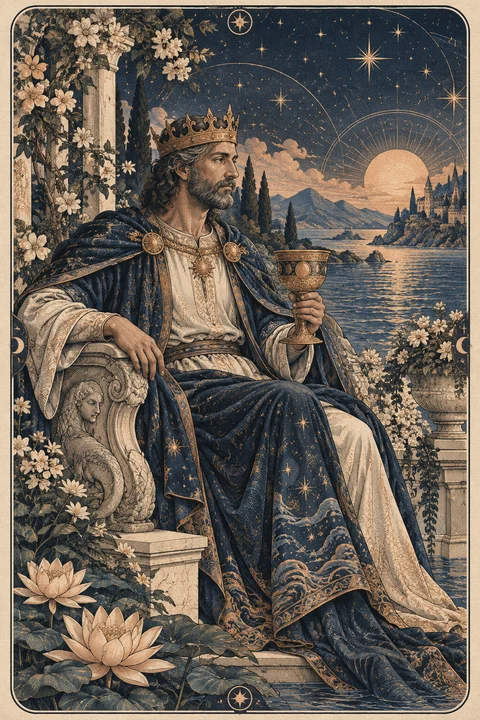
The King of Cups reversed meaning centers on emotional imbalance, suppressed feelings, or a struggle to maintain healthy personal boundaries. When this court card appears upside down, it traditionally suggests that emotional maturity has been compromised by stress, manipulation, or overwhelming moods. Rather than mastering the watery realm of feelings, the querent or someone influential in their life may be struggling to navigate emotional currents with calm objectivity.
Rider-Waite-Smith Symbolism of the Reversed King of Cups
In the traditional Rider-Waite-Smith Tarot deck, the King of Cups sits upon a throne floating amidst turbulent ocean waters. In his right hand, he holds a cup representing his connection to emotional depth, while his left hand holds a scepter symbolizing conscious authority. A leaping fish on his necklace and a ship sailing in the background reinforce the theme of balancing wild, subconscious instincts with disciplined navigation. The King is the ultimate master of Water, remaining calm and poised even while ocean swells surge around his stone seat.
When the card appears reversed, this carefully maintained equilibrium inverts. The throne appears unstable, threatening to plunge the ruler into the swirling waters below rather than keeping him secure above them. The water, which traditionally represents the unconscious, intuition, and raw sentiment, no longer answers to conscious discipline. Instead of guiding the vessel with steady wisdom, the figure in the card seems at the mercy of chaotic currents, hinting that unresolved feelings have gained control over clear judgment.
Tarot practitioners often observe that this reversal disrupts the harmonious partnership between thought and emotion. Rather than integrating his feelings through self-awareness, the reversed King may represent emotional suppression that erupts without warning, or an overwhelming flood of sentiment that clouds ethical discernment. By recognizing the visual distress of an inverted throne on water, a reader can immediately sense that stability within relationships or inner states has become fragile.
Core Interpretations: Blocked, Internal, Excess, or Lack
Modern Tarot readers approach reversals through several established frameworks, each offering a distinct angle on the King of Cups reversed meaning. The first common approach looks at blocked energy, suggesting that healthy emotional expression is being actively thwarted. In this reading, an individual possesses compassion and empathy, but external pressures, fear of vulnerability, or past trauma prevent them from sharing those gifts freely with the people around them.
A second common perspective treats the reversal as internalized energy. While an upright King radiates steady warmth and counsels others through difficult times, an internalized King directs that deep feeling entirely inward. This can manifest as private emotional self-reflection, quiet processing of grief, or silent inner resilience. However, if taken too far, internalizing these strong currents can lead to brooding isolation, where a person quietly nurses grievances instead of speaking their truth candidly.
The third and fourth frameworks examine excess versus lack. When Water energy runs in excess, the reversed King reflects emotional melodrama, volatile outbursts, self-pity, or subtle guilt-tripping designed to control social dynamics. Conversely, a lack of Water manifests as cold emotional detachment, cynicism, or callous indifference toward other people. Determining which framework applies depends on the querent's current situation and how the surrounding cards frame the emotional climate.
Differences Between Schools and Traditions
Interpretive traditions have long diverged on how court card reversals should be weighted. Classical French and golden dawn traditions often linked reversed court cards to specific negative personality traits or dishonorable archetypes, occasionally describing the reversed King of Cups as a dishonest man, a swindler, or an untrustworthy flatterer. These older interpretations viewed the reversal as a severe warning about deception, bad faith, or duplicitous behavior in one's social circle.
In contrast, psychological and modern intuitive schools prefer to read court cards as internal aspects of the self rather than fixed character judgments. Psychological readers view the reversed King of Cups as a snapshot of stress responses, such as regression into defensive mechanisms or struggles with emotional regulation. Rather than labeling someone as inherently malicious, this perspective asks where emotional maturity has momentarily broken down under duress, inviting compassionate self-inquiry rather than condemnation.
Some contemporary systems also examine the directional orientation of the card in relation to neighboring cards in a spread. If the reversed King faces toward an active suit like Wands or Swords, readers may interpret the conflict as an argument between wounded pride and unexpressed hurt. If the card faces away from the surrounding cards, practitioners often interpret the dynamic as emotional withdrawal, stone-walling, or a deliberate refusal to participate in open dialogue.
Understanding the King of Cups Reversed Meaning in Love and Relationships
In romantic consultations, the King of Cups reversed frequently signals a disruption in mutual trust, empathy, or healthy boundaries. When representing a partner, it can highlight an individual who struggles to regulate their moods, shifting unpredictably between warm affection and icy withdrawal. This inconsistency creates an exhausting environment where one person feels compelled to walk on eggshells to avoid triggering resentment or dramatic defensiveness.
The card can also point toward subtle forms of manipulation, such as playing the victim, leveraging emotional guilt, or withholding affection to gain leverage during disagreements. In established partnerships, this reversal often appears when one person has taken on the role of emotional caretaker, constantly absorbing the partner's unresolved stress at the expense of their own well-being. Codependency flourishes under these conditions because neither person is practicing clear, self-contained emotional ownership.
For single querents seeking romantic connections, drawing this card suggests caution when entering new bonds. It can serve as a gentle reminder to assess whether you are projecting an idealized fantasy onto people who lack true emotional availability. The card invites reflection on whether past emotional wounds are causing you to attract partners who require rescue, or whether your own reluctance to show vulnerability is keeping genuine companionship at arm's length.
Career, Finances, and Professional Dynamics
Within professional readings, the King of Cups reversed highlights workplace environments where logic has been overtaken by office politics, subjective favoritism, or passive-aggressive conflict. If representing a manager or colleague, the card describes a leader whose decisions are driven by personal insecurity or temperamental whims rather than balanced, objective strategy. Working under such leadership often leaves team members feeling uncertain about where they stand from day to day.
On a personal level, this reversal encourages the querent to evaluate their own professional composure. Intense workloads, challenging colleagues, or burnout can cause even the most composed worker to react impulsively or take constructive feedback as a personal insult. When this card appears, practitioners recommend pausing before hitting send on emotionally charged communications, taking a step back to regain neutrality before addressing sensitive organizational matters.
Financially, the reversed King warns against emotional spending or making critical investments while feeling anxious or overly optimistic. Money choices made under the influence of fluctuating feelings rarely produce stable results. Taking time to review factual budgets, consulting objective balance sheets, and sleeping on major purchase decisions are practical ways to realign with the King's upright mastery of balance and foresight.
How to Work with the King of Cups Reversed Meaning in Personal Growth
When the King of Cups reversed meaning surfaces in a personal growth spread, it provides a valuable invitation to rebuild your internal emotional foundation. The card asks you to notice where your feelings may be overpowering your wisdom, or where you might be shutting down your heart to avoid discomfort. Healing this rift begins with honest self-observation, acknowledging difficult feelings without judgment while refusing to let them dictate impulsive actions.
Establishing clear personal boundaries is central to integrating this card's wisdom. Consider asking yourself: Where am I taking responsibility for emotions that belong to someone else? Am I expressing my needs directly, or am I expecting others to read my mind and feeling resentful when they fail? Writing your uncensored feelings in a journal, setting aside quiet time to process grief, or practicing grounding breathwork can help restore calm to your inner waters.
Ultimately, this reversal reminds us that emotional mastery is not about perfection or the complete elimination of stormy moods. Rather, it is the ongoing discipline of returning to self-compassion, accountability, and clarity after the storm passes. By acknowledging your vulnerability and honoring your emotional limits, you transform the turbulent waters of the reversed King back into a peaceful reservoir of profound insight and genuine inner strength.
Frequently asked questions
What does the King of Cups reversed mean as a person?
As a person, the reversed King of Cups often represents someone who is emotionally turbulent, moody, or defensive. They may struggle with accountability, mask their vulnerabilities with passive aggression, or use emotional guilt to sway others. In milder situations, it simply describes a compassionate person currently overwhelmed by stress or grief.
Is the King of Cups reversed a yes or no card?
The King of Cups reversed leans toward a gentle no or a caution to delay. The card indicates that emotions are currently too chaotic or boundaries too blurred for an objective decision. It advises waiting until emotional clarity returns before committing to an important outcome.
How does the reversed King of Cups compare to the reversed Queen of Cups?
Both deal with emotional turbulence, but their expressions differ. The reversed Queen of Cups usually reflects inward insecurity, codependency, or martyrdom. The reversed King of Cups more often concerns external authority and governance, showing up as manipulative control, volatile temperament, or an inability to steer life steadily.
What should I do when I pull the King of Cups reversed in a daily draw?
Use the draw as an invitation to check your emotional barometer. Pause before responding to frustrating interactions, verify your personal boundaries, and avoid suppressing irritation. A short mindfulness practice or grounding walk can help you stabilize your feelings before navigating complex interpersonal situations.