King of Pentacles Reversed Meaning in a Tarot Reading
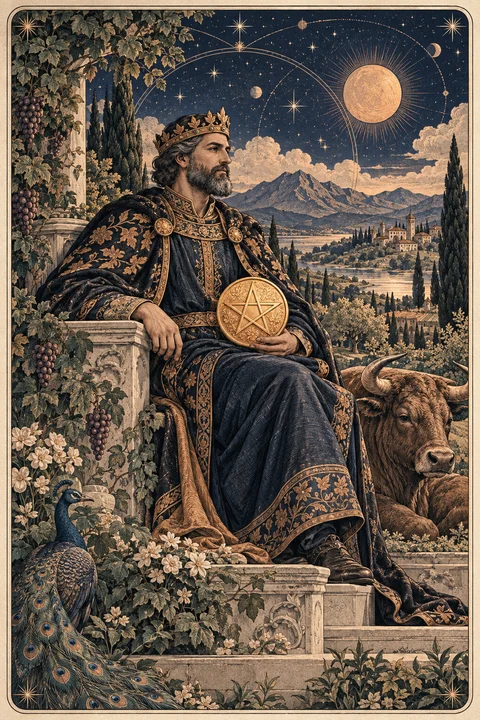
When it appears in a spread, the King of Pentacles reversed meaning traditionally points to an imbalance in material security, discipline, or personal authority. Instead of the upright ruler's grounded mastery, this reversal often reflects mismanagement, stubborn micromanagement, or an excessive fixation on external status. By examining how this energy manifests, you can identify where to restore healthy structure and cultivate genuine, lasting stability.
Symbolism of the Reversed King of Pentacles
In the traditional Rider-Waite-Smith system, the upright King of Pentacles sits comfortably on a carved throne adorned with bull heads, surrounded by lush vines and blooming flora. He holds a golden coin with quiet confidence, representing complete stewardship over the element of Earth. When inverted, this peaceful dominion feels compromised. The lush harvest may appear neglected or suffocated by greed, while his sturdy posture shifts into an image of instability or obstinate immobility.
Practitioners describe the reversal as a tipping point where practical caution deteriorates into fear of loss. The throne no longer anchors the King to fertile ground; instead, the weight of his heavy robes and golden crown feels burdensome. Readers often interpret this shift as a sign that relying too heavily on material achievements can blind someone to organic growth. Life becomes reduced to mere balance sheets and external validation.
Symbolically, the bull carvings evoke Taurus and fixed Earth, qualities associated with determination and tactile pleasure. When turned upside down, that dependable persistence easily curdles into unproductive resistance to change. The card asks you to notice where your desire for predictability might be preventing necessary transformation. Rather than fostering abundance, clinging rigidly to familiar routines can inadvertently drain the vitality you hope to protect.
Four Frameworks for the King of Pentacles Reversed Meaning
Many contemporary readers examine reversals through four primary lenses: excess, lack, internal experience, or blocked energy. When approaching the King of Pentacles reversed meaning through the lens of excess, the card frequently illustrates tyrannical control, ruthless ambition, or obsessive materialism. Someone embodying this extreme may treat people as assets and prioritize profit over basic human decency, creating an environment where organic connections cannot flourish.
Conversely, when viewed as a lack of energy, this inversion reflects poor financial stewardship, disorganization, or an inability to follow through on practical plans. The dependable provider disappears, replaced by someone who struggles with basic routines or avoids fiscal responsibility altogether. You might notice difficulty maintaining a stable schedule or managing day-to-day commitments, indicating that the grounding presence of mature Earth is currently missing.
When interpreted as an internal experience, the reversal suggests that you possess the competence of the King but fail to acknowledge it. You may struggle with imposter syndrome, constantly doubting your capacity to manage your resources or lead a venture. Even if your external life appears prosperous, internal anxiety whispers that you are one mistake away from ruin, prompting you to build genuine self-trust.
Finally, blocked energy indicates that external obstacles or outdated habits are preventing you from building your kingdom. You might have the vision and work ethic required for success, yet institutional delays or market shifts stall your momentum. Rather than forcing progress through sheer willpower, this nuance encourages patience and strategic recalibration while waiting for conditions to become more receptive to your efforts.
Work, Career, and Material Resources
In career readings, the reversed King of Pentacles often highlights professional burnout caused by unsustainable work habits. You may be pouring endless hours into a business or corporate role, yet feeling deeply unfulfilled because the work lacks genuine purpose. Alternatively, it can point to a difficult supervisor who exercises authoritarian leadership, micromanaging subordinates and refusing to share credit, signaling a need for firmer personal boundaries.
When financial topics arise, readers view this card as a gentle prompt to examine your relationship with money. It does not forecast inevitable loss, but it does encourage mindful budget review and practical realism. Speculative ventures, risky shortcuts, and ostentatious displays of wealth often backfire under this influence. Taking time to organize accounts and audit recurring expenses can help you regain footing before minor oversights escalate.
Consider whether you have fallen into the trap of measuring your personal value strictly through productivity metrics. In a culture that celebrates constant hustle, it is easy to assume that rest must be earned through total exhaustion. The reversed King reminds you that true wealth includes physical vitality, mental peace, and leisure time. Sustainable success requires a rhythm of replenishment, not relentless extraction of your energy.
Love and Personal Relationships
Within romantic partnerships, this reversal frequently surfaces when practical stressors overshadow emotional intimacy. Couples may find themselves conversing solely about household logistics, mortgage payments, or chore divisions, inadvertently letting affection wither away. The relationship starts feeling like a corporate merger rather than a loving union. Taking time for spontaneous dates and heartfelt conversations helps reignite warmth and reconnects partners beyond their practical obligations.
On an interpersonal level, the card can represent a partner who uses financial support as an instrument of control. They may offer lavish gifts or cover living expenses, but attach unspoken conditions that leave the other person feeling beholden or trapped. Alternatively, one person might display stubborn refusal to compromise on lifestyle decisions. Healing this dynamic requires honest dialogue about equity, mutual autonomy, and emotional reciprocity.
For single individuals seeking romance, the reversed King suggests evaluating the criteria you use to judge prospective partners. Are you screening people based primarily on their career status, wealth, or lifestyle presentation? While financial responsibility is a healthy boundary, prioritizing surface security over emotional compatibility rarely leads to lasting connection. Allow yourself to appreciate warmth, kindness, and vulnerability just as much as external accomplishment.
Divergent Traditions and School Perspectives
Different Tarot traditions approach court card reversals with varying philosophies. Classical British Golden Dawn techniques often emphasize the elemental dignity of the cards, viewing the King as Chokmah in Assiah, representing the active, masculine seed of Earth. When reversed or ill-dignified, the fiery aspect of the King clashes with the sluggishness of Earth, resulting in unbridled obstinacy or stubborn inertia that disrupts natural flow.
In contrast, the French Tarot de Marseille tradition historically does not rely on reversed card meanings, as reader interpretation focuses heavily on open-faced visual geometry and card directionality. When modern Marseille readers do account for inversions, they often interpret court reversals simply as inner psychological states rather than external obstacles. Understanding these distinct lineages demonstrates that no single interpretive system holds an absolute monopoly on symbolic wisdom.
Modern intuitive readers frequently combine these historical frameworks with psychological archetypes derived from Carl Jung. Seen through this lens, the reversed King represents the shadow aspect of the Provider or Sovereign archetype. Rather than an omen of misfortune, the card becomes a reflective mirror prompting you to explore how unconscious beliefs about scarcity, control, and worthiness are shaping your day-to-day decisions and interpersonal behaviors.
Integrating the King of Pentacles Reversed in a Reading
Interpreting this card effectively depends heavily on surrounding cards within your spread. If flanked by swords such as the Three of Swords or King of Swords, communication breakdowns and contractual friction may be compounding material challenges. Conversely, if paired with cups like the Five of Cups or Four of Cups, emotional discontent is likely driving your dissatisfaction with external achievements. Always allow the broader narrative to guide your understanding.
Practical reflection is the most potent response to this card. Ask yourself whether your current lifestyle honors your long-term values, or if you are simply running on an automatic treadmill of habit. Are there obligations you need to renegotiate, or investments of time that yield negligible fulfillment? Writing down your thoughts about stability and success helps clarify which structures still serve you and which have outlived their original utility.
Ultimately, understanding the King of Pentacles reversed meaning offers a valuable opportunity to recalibrate your relationship with authority, prosperity, and self-worth. It encourages you to exchange rigid perfectionism for resilient adaptability. By shedding the exhausting need to control every practical detail, you create space for organic abundance to flourish. True sovereignty lies not in holding tightly to assets, but in knowing that your inner resourcefulness remains steady.
Frequently asked questions
Is the King of Pentacles reversed always a bad sign in Tarot?
No single Tarot card is inherently positive or negative. The reversed King of Pentacles functions as a constructive diagnostic tool rather than a bad omen. It gently highlights areas where rigid control, neglect, or material anxiety might be undermining your security. Recognizing these patterns empowers you to make practical adjustments before minor stress becomes a lasting setback.
What does the King of Pentacles reversed mean for career growth?
In career spreads, this reversal typically suggests burnout, micromanagement, or misaligned professional goals. You might be staying in a stagnant role purely for financial predictability, or working with a demanding supervisor who restricts your growth. It invites you to assess whether your daily efforts support authentic advancement or merely keep you on an exhausting corporate treadmill.
How does the reversed King of Pentacles describe someone's personality?
When representing a person, the reversed King often depicts someone who is stubborn, overly transactional, or intensely materialistic. They may struggle to express affection outside of money or status, and they might exhibit controlling tendencies when feeling insecure. Alternatively, it can describe someone who appears irresponsible, unreliable, or incapable of managing basic domestic commitments.
What advice does the King of Pentacles reversed offer?
This card advises you to loosen your grip on rigid outcomes and conduct an honest audit of your practical life. Streamline your budget, set healthy boundaries around your work hours, and stop defining your value by external accomplishments alone. True stability comes from adaptable self-reliance and emotional presence, not from micromanaging every single detail around you.