King of Swords Reversed Meaning: Complete Tarot Guide
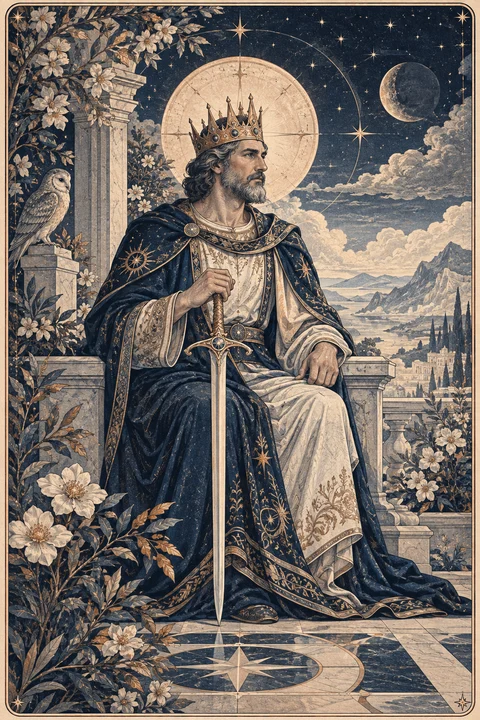
The King of Swords reversed meaning points to the misuse, distortion, or complete absence of mental clarity and ethical authority. In a traditional Tarot reading, this reversal suggests that intellect has turned overly harsh, manipulative, or disorganized, or conversely, that judgment is clouded by intense emotions and biased logic. Practitioners interpret this card as an invitation to examine how you use truth, authority, and communication in your daily life.
Understanding the King of Swords in the Rider-Waite-Smith Tradition
In the Rider-Waite-Smith system, the King of Swords represents the ultimate mastery of the element of Air, which governs thought, discernment, communication, and truth. The upright King sits firmly upon his throne, holding an upright sword of truth in his right hand while gazing outward with clear, dispassionate resolve. His authority rests on fairness, philosophical integrity, and the courage to make rational choices regardless of personal bias. He embodies sound governance, high standards, and the intellectual discipline required to perceive reality accurately without being swayed by illusion or sentimental impulse.
When this card appears inverted, that delicate balance between sharp mind and steady virtue collapses into disarray. The sword no longer points directly toward heavenly truth; instead, its sharp edge can signify cruelty, cynicism, or petty dogmatism. The card asks the querent to consider whether their current thoughts align with authentic discernment or if an inflexible attitude has hardened into stubborn arrogance. The foundational qualities of the suit of Air remain present, but their expression has become distorted, ineffective, or harmful to self and others.
Divination readers traditionally view court cards as multifaceted mirrors. A King can represent an active mindset, a specific phase of psychological maturity, or an actual person within the querent's environment. When working with the reversed King, readers look closely at surrounding cards to determine whether the card speaks of an external figure exerting cold control or an internal pattern of self-sabotaging overanalysis and harsh self-judgment.
Core Interpretations: Excess, Lack, and Internalized Air
Modern Tarot practitioners frequently analyze reversed cards through three distinct lenses: an excess of energy, a lack of energy, or an internal focus. Viewed as an excess of Air, the card displays intellectual tyranny. In this state, a person may weaponize logic to humiliate others, demand robotic perfectionism, or maintain emotional detachment to evade genuine vulnerability. Argumentation becomes a sport where winning matters far more than mutual understanding, leaving associates and loved ones feeling judged, dismissed, and emotionally exhausted.
Viewed as a deficit of Air, this card portrays mental brain fog, indecision, and poor analytical judgment. The querent might struggle to grasp fundamental facts, fall prey to logical fallacies, or act on impulse while mistakenly believing they are being completely rational. Critical thinking evaporates, leaving the person susceptible to disinformation or emotional manipulation. Without the sharp sword of discernment to cut through deception, plans quickly dissolve into chaos because the foundational strategy was built on flawed assumptions and weak organization.
When the card functions as an internal reflection, the sharp blade turns inward against the seeker. The individual may harbor a relentless inner critic that catalogs every failure and invalidates every natural emotional response. Instead of guiding the self with supportive structure, the mind behaves like an abusive tribunal. In these instances, the reversed King asks the seeker to silence that cold interior judge and cultivate a more generous, compassionate relationship with their personal humanity.
How Different Tarot Schools Interpret the Reversal
Interpretive traditions often disagree on how to treat reversed court cards, providing diverse avenues for study and practice. Classical fortune-telling manuals from the late nineteenth and early twentieth centuries tended to view this card with notable severity. Early commentators, including Arthur Edward Waite, described the inverted King as a litigious, cruel, and treacherous man who uses intellect to cause malicious harm or exploit legal technicalities. In that historical framework, the card served as a cautionary omen against ruthless opponents, corrupt officials, and deceitful advisers.
Conversely, psychological and modern humanistic schools of Tarot interpret reversals as blocked potential or unconscious defense mechanisms. Rather than diagnosing an outside villain, psychological readers explore where the querent suppresses their authentic authority. In this view, intellectual dogmatism is understood as a brittle armor worn by individuals who are privately terrified of losing control. The card highlights how extreme cynicism frequently masks deep unacknowledged grief, fear of vulnerability, or past experiences of intellectual humiliation.
Esoteric schools linked to the Hermetic Order of the Golden Dawn focus on elemental interactions and astrological attributions. Associating the King with the fiery aspect of Air, these practitioners study how rapid mental currents interact with surrounding cards. If surrounded by heavy Water cards, the inverted King might indicate logic being swamped by emotional volatility. When flanked by Wands or Swords, it can highlight volatile intellectual arrogance, aggressive arguments, and sudden disruptions caused by thoughtless, impatient speech.
The King of Swords Reversed Meaning in Love, Work, and Daily Life
In relationship readings, the card cautions against severe imbalances of power, condescension, and verbal cruelty. One partner may adopt a posture of moral and intellectual superiority, treating simple disagreements like courtroom trials where the other party must be dismantled. It can also point to calculated passive-aggression or deceitful communication. Healing requires setting firm boundaries against emotional coldness and making a conscious choice to practice empathy, active listening, and openhearted vulnerability instead of constant defensive debate.
Within professional and financial contexts, this reversal frequently identifies toxic managerial styles, micro-management, and corporate dishonesty. You might be navigating a workplace ruled by an unscrupulous executive who manipulates performance metrics, enforces arbitrary rules, or shifts blame onto subordinates. Alternatively, it may reflect your own career fatigue, showing up as analysis paralysis, disorganization, or cynical detachment from your daily tasks. In financial negotiations, it serves as an explicit reminder to inspect every contract, verify verbal promises, and avoid shortcuts.
For daily personal reflection, this card provides an invitation to examine communication hygiene and personal integrity. Are you speaking truth with kindness, or are you delivering criticism wrapped in self-righteous certainty? Are you avoiding an essential conversation because you fear emotional friction, or are you speaking rashly out of sheer irritation? Taking time for quiet contemplation helps you disarm unnecessary mental defensiveness and realign your words with constructive purpose and quiet confidence.
Reading the Card in Context: Surrounding Cards and Combinations
A Tarot card never operates in isolation, and the surrounding layout fundamentally shapes the expression of the reversed King. When paired with difficult cards from the suit of Swords, such as the Three of Swords or Five of Swords, the warning regarding cutting speech, betrayal, and hostility becomes pronounced. Such combinations suggest that intellectual conflicts have crossed into destructive territory, requiring swift boundary-setting or strategic disengagement before further emotional harm occurs.
When the card appears alongside softer cards from the suit of Cups, such as the Two of Cups or Queen of Cups, the narrative shifts toward healing. This pairing often indicates an opportunity to soften a rigid mindset with emotional empathy. The cards suggest that genuine understanding will not come from building an airtight argument, but rather from listening to the unspoken feelings beneath the conflict. In this context, the reversal marks a transitional moment where the mind finally learns to honor the wisdom of the heart.
Finally, pairing this reversal with major cards of personal transformation, such as The Tower or Justice reversed, signals a reckoning with false beliefs and unfair systems. These configurations warn that maintaining an inflexible stance or attempting to manipulate facts will inevitably lead to public embarrassment or structural failure. Readers encourage querents facing such combinations to surrender stubborn pride, admit mistakes candidly, and rebuild their plans upon transparent, indisputable truth.
Reflective Practices for Restoring Mental Clarity
When this card appears in your personal spread, practical exercises can help you recalibrate your mental faculties. Begin by stepping away from contentious discussions and high-stakes debates for at least twenty-four hours. Chronic overthinking creates cognitive fatigue, which directly breeds irritability and flawed logic. Taking deliberate mental rest breaks the feedback loop of defensive rationalization, allowing your nervous system to settle and restoring your natural capacity for balanced, calm evaluation.
Writing down your thoughts without self-censorship offers another powerful method for processing this energy. Draft your unfiltered opinions, anxieties, and frustrations onto paper, then read them through the eyes of an impartial, compassionate observer. Identify where your language contains hyperbolic absolutes such as 'always' or 'never', as these phrases typically point to cognitive distortions rather than objective reality. Editing your own thoughts on the page helps you reclaim the healthy, upright discernment of the suit of Air.
Ultimately, understanding the King of Swords reversed meaning enables you to transform intellectual conflict into personal wisdom. Divination acts as a symbolic mirror rather than an unchangeable verdict of fate. By recognizing where your thoughts have grown cold, confused, or overly rigid, you gain the conscious agency to lay down destructive verbal weapons, cultivate authentic mental clarity, and navigate your life with steady, compassionate wisdom.
Frequently asked questions
Does the King of Swords reversed indicate a dishonest person?
Traditionally, many readers associate this card with dishonesty, manipulation, or someone who twists facts to suit their agenda. However, it can also represent someone whose logic is simply clouded or who communicates clumsily without malicious intent. Always examine surrounding cards before assuming conscious deceit.
What should I do when I pull this card for career guidance?
Take time to review your documents, verify professional agreements, and avoid getting pulled into office politics or harsh arguments. If you are leading a team, ensure you are providing clear, supportive directions rather than micromanaging or offering overly critical feedback to your colleagues.
Is the King of Swords reversed always a negative omen?
Tarot symbolism serves reflection rather than fixed fortune-telling. While the card highlights challenges like miscommunication, rigid thinking, or mental fatigue, it also offers constructive guidance. It encourages you to drop defensive mental armor, acknowledge your emotions, and restore genuine intellectual balance.
How does this card differ from the Queen of Swords reversed?
While both cards address distorted Air energy, the Queen traditionally reflects emotional boundaries that have hardened into bitterness, cold isolation, or sharp personal defense. The King more commonly points to outward authority, societal systems, strategic leadership, and formal decision-making gone awry.