Knight of Cups Reversed Meaning in a Tarot Reading
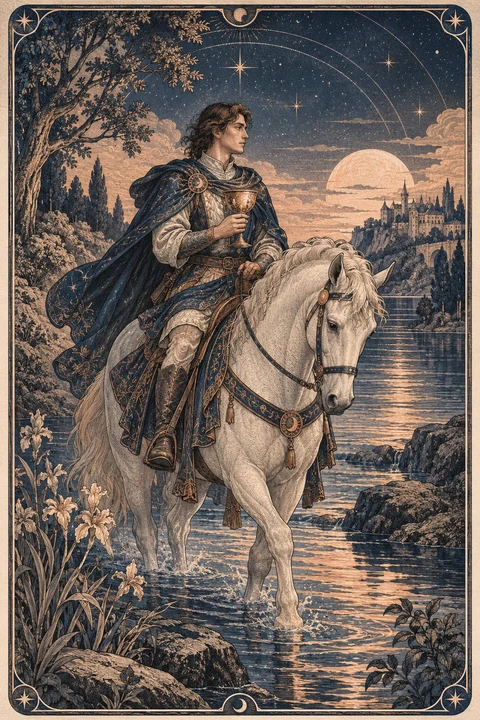
When the Knight of Cups appears inverted, it signals that emotional impulses, romantic fantasies, or creative pursuits have lost their grounding. At its foundation, the knight of cups reversed meaning points to emotional unreliability, creative avoidance, or disillusionment caused by unrealistic expectations. Rather than bringing a sincere message of love or artistic inspiration, this reversal asks you to pause, examine your inner state, and separate emotional truth from sentimental projection.
Understanding the Knight of Cups in the Rider-Waite-Smith Tradition
In the traditional Rider-Waite-Smith deck, the Knight of Cups rides a gentle, pacing steed beside a winding river. Cloaked in a tunic patterned with fish, the universal symbol of the unconscious mind and spiritual perception, this knight carries a solitary chalice forward as an offering. Unlike the fiery Knight of Wands or the assertive Knight of Swords, this figure moves deliberately and calmly. The suit of Cups corresponds to the element of Water, which governs our emotional attachments, spiritual yearning, intuition, and intimate bonds. Therefore, the upright knight embodies the poet, the peacemaker, and the noble romantic who leads directly with the heart.
When this card is turned upside down, the poised energy of Water loses its equilibrium. The horse halts, stumbles, or wanders aimlessly into emotional terrain that has become swampy and treacherous. The cup, once extended as a genuine pledge of devotion or creative inspiration, threatens to spill its contents or turns out to be hollow. Rather than channeling emotional sensitivity into constructive art or meaningful connection, the reversed knight represents an energy that has become overwhelmed by fantasy, fear, or self-absorption. Understanding this reversal begins with recognizing that the underlying elemental desire for connection has not vanished, but its outward expression has been warped.
Tarot readers view court cards not only as external personalities you might encounter in everyday life, but also as internal facets of your own psyche. When interpreting this figure, practitioners assess whether the card reflects a specific person who is acting carelessly with your feelings, or if it mirrors an internal habit of running away into daydreams whenever emotional reality demands practical maturity. By grounding the symbol in the Rider-Waite-Smith system, you can clearly trace how the knight's natural virtues mutate into their shadow counterparts.
Core Knight of Cups Reversed Meaning: Four Common Perspectives
Modern Tarot practitioners generally evaluate reversed cards through four primary lenses: blocked energy, internalized energy, an excess of the archetype, or a deficiency of the archetype. Applying these lenses to the knight of cups reversed meaning clarifies how the card functions within a spread. When viewed as blocked energy, the card suggests that genuine feelings are being suppressed due to fear of vulnerability. You might want to express deep affection or start an imaginative project, yet an emotional dam prevents the water from flowing freely into the external world.
As an internalized experience, the reversed Knight of Cups invites a private, introspective journey. Instead of seeking romance, validation, or artistic applause from outside sources, the reader is called to cultivate self-compassion and emotional healing within. In this quiet state, the knight rides inward to explore complex feelings without needing an audience. Many readers consider this the most therapeutic manifestation of the card, because it allows you to soothe personal insecurities before attempting to connect deeply with others.
When the card manifests as an excess of the suit, it reveals melodrama, hypersensitivity, and intense escapism. Here, the knight drowns in subjective sentimentality, taking every perceived slight to heart and constructing elaborate narratives that have no basis in reality. Conversely, a deficiency of this energy manifests as emotional numbness, cynicism, and cold detachment. In this state, an individual has shut down their intuitive gifts entirely, often as a defensive reaction to previous heartbreak or artistic rejection, refusing to believe in beauty, love, or goodwill.
The Reversed Knight of Cups in Love and Relationships
In relationship readings, the inverted Knight of Cups frequently appears as a warning sign regarding emotional authenticity and communication. Traditionally, the upright knight is the classic fairy-tale suitor who sweeps you off your feet with poetic declarations. Reversed, this figure often represents someone who falls in love with the intoxicating concept of romance rather than the actual human being sitting across from them. This dynamic can manifest as love-bombing, where someone showers you with immense affection and grand promises early on, only to vanish or pull away when the mundane realities of commitment set in.
For couples, this card can point to lingering passive-aggressive behavior, mood swings, or emotional manipulation. One or both partners may be hiding behind silent treatments, expecting their significant other to instinctively read their mind instead of articulating genuine needs with clarity. When disappointment inevitably occurs, the hurt partner retreats into sulking or resentment. The card asks both parties to strip away sentimental illusions and examine whether they are treating the relationship as an honest partnership or as an unrealistic drama where each person plays an idealized role.
If you are single and inquiring about romance, the card frequently urges self-examination regarding your dating standards. Are you holding potential suitors to an impossible, cinematic ideal that no living person could ever satisfy? Alternatively, you might find yourself consistently drawn to emotionally unavailable individuals, hoping your devotion will miraculously heal their private wounds. The reversed knight gently reminds you that authentic intimacy requires mutual emotional maturity, reliability, and emotional presence, none of which can thrive on romanticized fantasies alone.
Creative Blocks and Career Ambitions
In readings centered on work and vocation, the Knight of Cups reversed represents a disconnect between artistic vision and practical execution. This card often symbolizes the talented dreamer who possesses an abundance of brilliant ideas but lacks the discipline to finish any of them. You may find yourself perpetually outlining novels, planning businesses, or starting canvases, only to abandon them the moment the initial rush of inspiration fades into routine labor. The reversal highlights procrastination masquerading as a search for the perfect muse, cautioning you that inspiration rarely sustains a career without steady perseverance.
Within the workplace environment, this inverted court card can also describe colleagues or superiors who struggle with professionalism due to volatile personal emotions. It highlights individuals who take constructive feedback as a devastating personal insult, or who make promises regarding promotions, raises, and collaborative projects that they ultimately fail to honor. When navigating these professional situations, it is essential to keep interactions documented, maintain clear personal boundaries, and avoid getting swept into office drama or sentimental alliances that compromise your own stability.
If you are feeling completely uninspired in your current occupation, this card suggests that your daily tasks may be draining your spirit and ignoring your deeper values. However, rather than making an impulsive, dramatic exit fueled by frustration, the card advises crafting a grounded transition plan. Take time to clarify what kind of meaningful work truly aligns with your core nature, and address any internal fears of failure that might be causing you to stall your professional growth.
School Differences: Continental, Golden Dawn, and Modern Systems
Interpretations of the reversed Knight of Cups vary across different esoteric schools and historical traditions. In the Hermetic Order of the Golden Dawn system, court cards are assigned distinct elemental combinations; the Knight of Cups represents the fiery part of Water. Fire provides motivation and impulse, while Water provides emotion and receptivity. In an upright position, this blend yields passionate, devoted action. However, Golden Dawn practitioners describe the reversal as fire boiling the water away into vapor, creating an unstable, deceptive, or idle character who is easily swayed by external flattery and sensory indulgence.
In contrast, older Continental European traditions, such as those associated with the Tarot of Marseilles and early French cartomancy, relied heavily on fixed divinatory keywords rather than psychological archetypes. In these classic systems, the reversed Knight of Cups was often interpreted very literally as trickery, fraud, an insincere arrival, or the uncovering of an untrustworthy visitor. The emphasis was placed squarely on external events and social interactions rather than internal psychological development or spiritual exploration.
Contemporary psychological Tarot frameworks, heavily influenced by archetypal psychology, bridge these perspectives by viewing the card as an invitation to integrate the shadow self. Instead of labeling the card as an intrinsically bad omen or warning of an outright villain, modern readers encourage seekers to look at their own capacity for self-deception and emotional avoidance. This evolution in interpretation shifts the focus from external misfortune toward conscious personal accountability, helping individuals recognize where their own subjective projections distort objective reality.
How to Read the Reversed Knight in Context
A Tarot card never exists in a vacuum, and the surrounding cards in a layout provide essential context for interpreting the reversed Knight of Cups accurately. For example, if this card appears alongside the Seven of Cups or The Moon, the reading heavily emphasizes profound self-deception, illusions, or escapist habits such as substance use or digital detachment. In this combination, the cards strongly indicate that perceptions are skewed and decisions should be deferred until emotional clarity returns.
Conversely, if the reversed knight sits beside grounding Earth cards, such as the King of Pentacles or the Eight of Pentacles, the message often indicates that disciplined work and practical structures will successfully remedy emotional chaos. In such a spread, practical habits, financial prudence, and daily routines act as steady banks that direct the knight's overflowing emotional river toward productive goals. Surrounding Swords cards, such as the Three of Swords or Queen of Swords, might point to painful communication, harsh truths cutting through sentimental denial, or the necessary process of grieving an illusion.
When this card appears in your layout, begin your reflection with thoughtful questions: Where in my life am I avoiding the truth in favor of a comforting fantasy? Am I expecting someone else to rescue me from my emotional responsibilities? How can I transform idle daydreams into grounded, practical actions today? By exploring these questions, you turn an unsettling card into a powerful catalyst for personal maturation.
Embracing Emotional Maturity Through the Knight of Cups Reversed
Ultimately, integrating the knight of cups reversed meaning into your personal journey is an exercise in cultivating deep self-honesty and emotional resilience. While encountering an inverted card can initially feel disappointing, this symbol acts as a helpful mirror, pointing out where your heart and mind have fallen out of sync. It asks you to step away from passive daydreaming and reclaim agency over your emotional life, recognizing that true romance, authentic art, and genuine peace are built upon a foundation of truth rather than escapism.
As you work with this card in your personal practice, treat its appearance as an empowering invitation to mature your emotional gifts. Water remains one of the most powerful elements in Tarot, possessing the capacity to nourish, heal, and transform everything it touches. By acknowledging where your emotional waters have turned stagnant or volatile, you can gently steer your inner knight back onto solid ground, offering your gifts to the world with renewed sincerity, integrity, and grace.
Frequently asked questions
Does the reversed Knight of Cups always represent an untrustworthy person?
No, it does not always represent another individual. In many readings, this card reflects your own internal state, such as feeling emotionally burned out, engaging in wishful thinking, or struggling to complete a creative project. When it does signify another person, it often describes someone who is emotionally immature, flaky, or avoidant rather than intentionally malicious.
What should I do if the reversed Knight of Cups appears in a reading?
Pause and evaluate your current situation objectively before making emotional commitments. Take time to verify facts rather than relying solely on assumptions, charm, or promises. Focus on grounding yourself through practical routines, express your boundaries clearly, and channel your emotional sensitivity into tangible actions rather than retreating into passive daydreams.
Is the Knight of Cups reversed a definite 'no' in a yes-or-no spread?
Traditionally, practitioners interpret the reversed Knight of Cups as a 'no' or at least a 'not yet.' Because the card signals emotional confusion, unreliability, and obscured facts, moving forward with the matter in question right now may lead to disappointment. It suggests waiting until you have clearer information and greater emotional stability.
How does this card differ from the reversed Page of Cups?
While both cards belong to the watery suit of Cups, the Page represents youthful beginnings, initial emotional messages, and intuitive curiosity. Reversed, the Page usually points to childish tantrums, insecurity, or creative shyness. The Knight represents movement, drive, and active pursuit; reversed, it reflects deeper patterns of romantic idealization, moodiness, and unfulfilled promises.