Six of Pentacles Reversed Meaning: A Tarot Guide
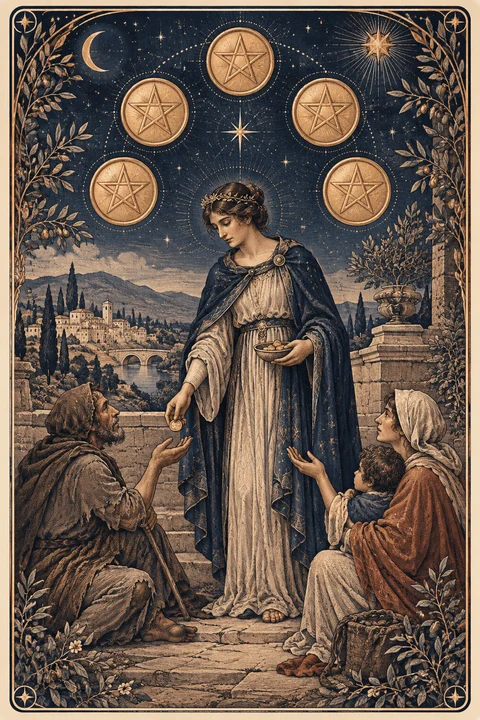
The Six of Pentacles reversed meaning centers on material imbalance, unequal exchanges of energy, and strings attached to generosity. When inverted, this Earth-aligned card suggests that charity may have turned into control, debts are going unpaid, or one party is giving far more than they receive. It invites readers to look closely at dependency, hidden obligations, and financial boundaries.
The Core Imagery and Symbolism of the Six of Pentacles Reversed
In the traditional Rider-Waite-Smith deck, the upright card shows a merchant dressed in purple holding scales while placing coins into the cupped hands of two kneeling figures. When the card appears reversed, this carefully calibrated system of exchange tips over. The balanced scales no longer measure equal weights, reflecting an environment where fairness has disappeared. The merchant's apparent kindness shifts into something less egalitarian, transforming assistance into an instrument of hierarchy, surveillance, or quiet domination.
The suit of Pentacles corresponds with the classical element of Earth, governing the practical facets of existence such as money, employment, resources, and the physical body. A reversal in this suit demonstrates that material energy is not circulating freely. Instead of an open cycle where resources flow smoothly between those who possess surplus and those experiencing scarcity, the inversion suggests stagnation, hoarding, or predatory behavior. The receiver may feel demeaned, while the giver may feel drained or manipulative.
Symbolically, the upside-down merchant points toward unchecked patronage. In many historical societies, wealthy patrons controlled the livelihoods and creative freedom of artists, laborers, and dependants under the guise of benevolence. When this archetype flips, the quiet contract of gratitude becomes burdensome. The seeker is encouraged to look past outward displays of goodwill to uncover whether quiet debts, unspoken expectations, or social subjugation are lurking beneath charitable acts.
Four Interpretive Lenses: Blocked, Internal, Excess, and Lack
Modern Tarot practitioners often interpret reversals through four distinct diagnostic lenses: blocked energy, internal experience, excess, and lack. When viewed as blocked energy, the card indicates that anticipated assistance is being withheld or stalled. You might be waiting on a loan approval, an inheritance, an overdue payment, or support from an institution that refuses to release funding. Communication breakdowns or institutional bureaucracy can leave you stranded without the resources you were promised.
Through the lens of internal experience, the reversal shifts the inquiry inward toward self-worth and psychological boundaries. Readers often see this card reflect individuals who refuse to ask for help because they view vulnerability as personal failure. Alternatively, it reflects an internal belief that you are only worthy of love and acceptance if you continuously rescue other people. Here, the external exchange of money symbolizes an internal negotiation about human value and emotional security.
When examined through excess and lack, the dynamic splits into two extreme poles. The pole of excess represents aggressive overspending, lavish gifts that purchase influence, or smothering benefactors who insist on managing your life choices. The pole of lack points toward unpaid wages, exploitation in the workplace, or complete depletion of personal savings. Both extremes break the golden rule of the suit of Pentacles, which demands that the material world be sustained through sustainable balance.
Six of Pentacles Reversed Meaning in Work and Finances
Within career readings, the six of pentacles reversed meaning frequently warns of unequal compensation, credit theft, and toxic power dynamics in the workplace. An employer may demand unpaid overtime, frame professional exploitation as mentorship, or dangle future promotions that never materialize. If you are an entrepreneur or independent freelancer, this card often shows clients who delay invoices, dispute agreed rates, or expect endless revisions without providing appropriate compensation.
From a financial perspective, this card strongly urges prudence, transparency, and careful auditing. It points toward scams masquerading as genuine investments, high-interest loans with predatory terms, or disputes over inheritances and shared property. The reversal cautions against co-signing contracts for individuals who have demonstrated reckless financial habits, as you may be left bearing the legal responsibility alone. It is not an ideal moment to lend money to acquaintances unless you are fully prepared to treat the sum as an outright gift.
The card also serves as a mirror for your own ethical conduct in commerce. If you manage employees or supervise vendors, consider whether your payment schedules and labor expectations are genuinely fair. Material success built on underpaying assistants or taking advantage of desperate contractors produces fragile results in the long run. The reversed card calls for strict adherence to equitable contracts, clear paper trails, and honest negotiations across all monetary interactions.
Relationship Dynamics and One-Sided Generosity
In relationship readings, the reversed Six of Pentacles is a classic marker of emotional and domestic asymmetry. One partner frequently assumes the role of the perpetual caretaker, managing household logistics, emotional labor, and shared finances while the other partner acts as a dependent child. This imbalance breeds resentment over time, as the caretaker feels exploited while the dependent partner feels judged, controlled, and stripped of personal autonomy.
The reversal also highlights the dangerous presence of financial abuse or conditional generosity within romantic partnerships. Gifts should not come with emotional ledger sheets where every dinner, trip, or favor is recorded to win future arguments. If an individual uses wealth to dictate where their partner goes, whom they socialize with, or what opinions they express, the partnership is no longer an association of equals. True reciprocity requires that emotional and practical support be offered without coercion.
For seekers who are currently single, this card suggests reflecting on dating patterns that mirror historical caretaking habits. You may find yourself continually drawn to prospective partners whom you hope to fix, save, or finance, mistaking rescue operations for romantic intimacy. Practitioners advise looking for connections where reciprocity is built into the foundation from the very beginning, ensuring that your energy is received with gratitude rather than entitlement.
Comparing Historical and Modern School Approaches
The understanding of the Six of Pentacles has evolved significantly across different esoteric schools over the past two centuries. Nineteenth-century French occultism, particularly through the teachings of Etteilla, assigned very specific prognostications to the inverted card, emphasizing unrequited ambition, desire, jealousy, and cutthroat social climbing. Early systems often approached reversals as direct opposites or sinister degradations of upright meanings, focusing heavily on concrete external misfortunes.
Arthur Edward Waite offered a more layered nuance in the early twentieth century. Waite noted that while the upright card represents presents, gifts, and prosperity, the reversal points toward desire, cupidity, envy, jealousy, and illusion. He recognized that when charity is motivated by vanity rather than compassion, the exchange becomes spiritually corrosive for everyone involved. The Golden Dawn tradition aligned this card with the Moon in Taurus, blending the deep instinctual need for emotional security with stubborn material attachments.
Contemporary psychological Tarot readers, influenced by twentieth-century humanistic thinkers, generally set aside fatalistic predictions in favor of cognitive and relational awareness. Rather than warning of inevitable theft or financial ruin, modern readers view the reversal as an energetic diagnostic tool. It asks the querent to evaluate their conscious relationship with power, mutual aid, vulnerability, and stewardship, treating the card as an actionable prompt for rebalancing systemic imbalances.
Reflective Steps to Heal Imbalance in Daily Life
When this card appears in your spread, consider engaging in a deliberate inventory of your current energetic investments. Take a blank sheet of paper and draw two columns representing what you give and what you receive across your closest professional and personal relationships. Be entirely truthful about whether you are giving out of genuine love or out of an unconscious desire to manipulate outcomes and avoid abandonment. Unspoken expectations are premeditated resentments waiting to happen.
Next, practice establishing firm, non-negotiable boundaries around your tangible resources. If someone repeatedly asks for loans without demonstrating effort to resolve their underlying habits, love may require saying no. Healthy boundaries preserve relationships that would otherwise drown under the weight of financial entitlement. Conversely, if you are the person relying heavily on others, take concrete steps to rebuild your independence and acknowledge the sacrifices others make on your behalf.
Reflecting deeply on the six of pentacles reversed meaning reminds us that true generosity always liberates both parties. Dignity must be preserved on both sides of the exchange. By releasing the urge to rescue, rejecting conditional favors, and establishing fair agreements, you can clear away parasitic patterns and cultivate genuine, lasting stability within your personal and material community.
Frequently asked questions
Does the Six of Pentacles reversed always indicate financial trouble?
Not necessarily. While it often flags financial mismanagement, unpaid debts, or unfair work agreements, it is equally common for the card to highlight emotional imbalances. It frequently points to one-sided friendships, romantic dynamics where one partner does all the emotional heavy lifting, or personal struggles with asking for help when you truly need it.
What should I do if the Six of Pentacles reversed appears as advice?
When drawn as advice, the card suggests cutting off parasitic situations and establishing firm boundaries around your time, money, and emotional energy. Stop offering unasked-for rescues to adults who refuse to help themselves, examine whether you have accepted gifts with hidden strings, and ensure you are being fairly compensated for your daily labor.
Can the Six of Pentacles reversed represent outright scams or fraud?
Yes, many practitioners interpret this reversal as a warning against financial deception, predatory lending, or bogus charitable causes. When accompanied by cards like The Moon or the Seven of Swords, it urges you to read the fine print carefully, verify credentials, and avoid speculative opportunities that promise guaranteed, effortless returns.
How does the Six of Pentacles reversed differ from the Five of Pentacles?
The Five of Pentacles represents outright material destitution, isolation, and feeling cast out in the cold. In contrast, the Six of Pentacles reversed still involves resources and exchanges, but the mechanism of distribution is dysfunctional, conditional, or manipulative. The Five depicts poverty, whereas the reversed Six depicts an unfair, oppressive dynamic between givers and receivers.