The Hierophant Reversed Meaning: A Tarot Guide
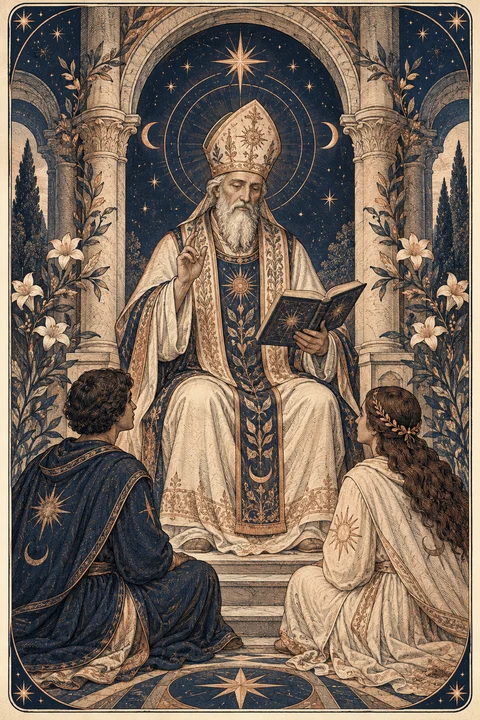
In a Tarot reading, the Hierophant reversed meaning represents a challenge to orthodoxy, a break from rigid dogma, or an awakening of personal spiritual autonomy. While the upright card embodies institutions, conformity, and external authorities, its inversion encourages you to question inherited doctrines and construct your own authentic value system. Many readers view this card as a symbolic invitation to examine where outdated customs constrain individual growth.
The Core Symbolism of The Hierophant in Reverse
Card number five of the Major Arcana, The Hierophant, depicts an ecclesiastical teacher seated between two stone pillars of sacred law, holding a triple cross and raising his hand in blessing before two acolytes. In the Rider-Waite-Smith system, this imagery reflects shared culture, institutional wisdom, and collective initiation. When the card appears upside down, the visual balance shifts significantly. The keys of heaven fall from the foreground, the pillars lose their stable foundation, and the raised hand of orthodox benediction turns downward into personal sovereignty.
Rather than receiving instruction from an external teacher, the querent must now look within to determine what rings true. Divination traditions do not treat this inverted figure as inherently hostile or corrupt, but rather as an emblem of spiritual puberty. It represents the moment an individual moves beyond simply repeating inherited lessons and begins to test doctrines against lived experience. Where the upright card suggests going to school, joining a church, or honoring standard etiquette, the reversal signals that old rules no longer address the present reality.
Symbolically, card five sits between the domestic stability of The Emperor and the moral agency of The Lovers. While The Emperor builds worldly structures, The Hierophant provides the moral and social codes that justify them. Reversing this influence often reflects a deep psychological realization: conventions created to preserve safety can easily transform into prisons of obedience. When this card appears, practitioners describe it as a prompt to evaluate which traditions nourish the spirit and which have hardened into hollow performative rituals.
Understanding the Hierophant Reversed Meaning Across Core Frameworks
To interpret the Hierophant reversed meaning accurately, many readers divide reversals into distinct operational categories rather than assuming a single static definition. The first category is blocked energy, where an individual desires access to standard mentorship, traditional credentials, or institutional membership but encounters closed doors. In this reading, bureaucratic hurdles or gatekeepers refuse passage, forcing the querent to seek alternative routes to validation. The conventional pipeline is stalled, calling for patience or creative detours around inflexible hierarchies.
The second category involves internalized expression, where the archetypal teacher operates from within rather than through an external organization. In this psychological perspective, you do not need a priest, counselor, or authority figure to grant permission for your choices. You are developing your own moral compass through introspective self-examination. The seeker synthesizes personal values independently, trusting conscience over communal doctrine, which frequently marks a critical threshold in emotional maturity and self-trust.
Finally, readers look at extremes of excess or lack. In excess, The Hierophant reversed reflects dogmatism, stubborn fundamentalism, and tyrannical adherence to the letter of the law while ignoring its spirit. Conversely, a lack of this energy manifests as complete rebellion without substance, characterized by chronic distrust of helpful rules, reckless disregard for cultural roots, or resisting wise counsel simply for the sake of contradiction. Determining which framework applies requires looking closely at the seeker's real-world circumstances.
Historical Schools and Divergent Reader Traditions
Interpretive approaches to this reversal differ across distinct Tarot traditions and historical lineages. Early French esoteric systems, including the teachings surrounding the Tarot de Marseille, often associated Le Pape with benevolence, paternal care, and worldly advice. In those historic frameworks, an inverted Pope was often regarded with caution, warning of malicious counselors, hypocrisy, narrow-minded bigotry, or deceptive promises from those claiming spiritual virtue. The emphasis rested primarily on social betrayal and unreliable authority figures.
The Hermetic Order of the Golden Dawn and later Arthur Edward Waite introduced nuanced esoteric layers connected to astrological rulerships. Attributed to the fixed earth sign Taurus, The Hierophant represents spiritual knowledge manifested through concrete physical ceremony and enduring structures. When upside down, the stubborn, earthy nature of Taurus can become an insurmountable resistance to change. Modern esoteric practitioners note that this astrological tension reflects an institution that has calcified, refusing vital evolutionary reform in order to preserve existing power.
Contemporary psychological Tarot readers, drawing upon Carl Jung and post-modern self-reflection practices, view the reversal much more favorably. Rather than treating it as an omen of bad advice or institutional punishment, modern interpreters see it as individuation. In this modern context, the querent actively breaks out of the collective unconscious conditioning instilled by family, schooling, and society. The card ceases to be a warning and becomes a validation of original thinking, personal philosophy, and creative spiritual exploration.
Love, Career, and Personal Growth Scenarios
In relationship readings, The Hierophant reversed frequently highlights friction regarding conventional milestones such as formal marriage, parental approval, or cultural relationship norms. A couple may discover that traditional expectations place unnatural strain on their partnership, inspiring them to design a unique relationship structure instead. For single individuals, this card may suggest breaking free from ingrained dating scripts, letting go of family criteria regarding what a suitable partner looks like, or learning to validate oneself without seeking social approval.
In professional inquiries, this card consistently highlights clashes with corporate bureaucracy, restrictive company cultures, or rigid industry gatekeepers. It often appears when an ambitious employee feels suffocated by outdated protocols or realizes that advancing up the traditional corporate ladder compromises personal integrity. Practitioners often interpret this as a call to pursue freelance work, launch an unconventional business venture, or act as an internal reformer who challenges outdated methods with modern, ethical alternatives.
For personal growth and spiritual wellness, the reversal encourages building an intuitive practice completely free from dogmatic guilt. You might find solace in blending practices from varied traditions or letting go of inherited religious shame that no longer serves your emotional health. When reflecting on this energy, you can ask yourself: Which beliefs did I inherit that I have never actually questioned? Where am I sacrificing my authentic voice simply to maintain social approval or avoid conflict?
Reading The Hierophant Reversed in Context
No Tarot card operates in isolation, and The Hierophant reversed depends heavily on its neighboring cards to clarify whether rebellion brings liberation or chaos. If accompanied by challenging cards like The Tower or the Five of Swords, the reversal may indicate painful organizational disruption, bitter ideological feuds, or the destructive consequences of reckless insubordination. In such combinations, breaking the rules might carry immediate legal, communal, or financial repercussions that demand careful consideration and measured diplomacy.
Conversely, when flanked by empowering cards such as The Star, The Fool, or the Eight of Pentacles, the reversal speaks of profound creative independence and authentic craftsmanship. It signals that stepping away from the herd will lead directly to meaningful self-discovery, spiritual renewal, and unique vocational mastery. In these encouraging configurations, departing from mainstream conformity is not merely safe; it represents an essential rite of passage necessary for long-term personal fulfillment and genuine intellectual honesty.
Court cards appearing nearby provide vital clues about who embodies this nonconformist tension in your daily environment. A King or Queen appearing upright next to The Hierophant reversed might represent a traditional supervisor, mentor, or parent whose expectations you must navigate carefully. If a court card appears reversed alongside it, the spread may point to your own rebellious impulse, advising you to examine whether your current defiance stems from thoughtful principle or defensive pride.
Integrating The Hierophant Reversed Meaning into Daily Life
Navigating the Hierophant reversed meaning ultimately requires balancing personal freedom with practical discernment. Tearing down traditional structures without having a replacement can leave a person feeling adrift, isolated, and without anchor. Healthy rebellion does not mean rejecting every rule out of spite; it means intentionally keeping the traditions that promote ethical living, community care, and self-respect while discarding customs that encourage subservience, unearned guilt, or intellectual stagnation.
When this card appears in your personal reflections, take time to journal about the authorities you hold sacred in your life. Consider whether you place excessive faith in external gurus, societal expectations, or prestigious credentials while discounting your personal intuition. Divination traditions present these archetypes to stimulate self-honesty rather than to dictate actions. Practicing critical thinking allows you to appreciate ancient traditions without being enslaved by their historical limitations or rigid social hierarchies.
In conclusion, working with the Hierophant reversed meaning invites you into the role of your own high priest and moral arbiter. By honoring your personal lived experience, remaining open to learning, and courageously speaking your truth, you create an honorable personal path. The reversal reminds us that while institutions may hold historical archives, true wisdom cannot be institutionalized; it must be discovered, tested, and lived by each individual seeker with conscious awareness.
Frequently asked questions
What does The Hierophant reversed mean as feelings?
When representing feelings, this card suggests a sense of restriction, boredom with predictable routines, or skepticism toward established authority. A person may feel unwilling to commit to rigid social expectations or traditional relationship timelines. It can also indicate feeling misunderstood by conventional family members or yearning for greater personal authenticity.
Is The Hierophant reversed a yes or no card?
The Hierophant reversed generally tilts toward a cautious 'no' regarding traditional approaches, institutional support, or orthodox solutions. However, it functions as a strong 'yes' for independent projects, breaking away from conformity, or seeking unconventional alternatives. The overall answer depends heavily on whether your question favors tradition or original innovation.
Does The Hierophant reversed indicate a breakup?
Not necessarily. While it can highlight disagreements regarding conventional expectations like marriage, living arrangements, or religion, it primarily signals that standard formulas are failing the partnership. Couples willing to renegotiate expectations and forge their own non-traditional ground rules often find clarity and renewed intimacy through this card's message.
How does The Hierophant reversed differ from The Devil?
While both cards explore control and societal conditioning, their core motives differ. The Hierophant reversed deals with social dogma, philosophical nonconformity, and questioning institutions. The Devil deals with material entrapment, addiction, compulsive behaviors, and shadow impulses where one gives away personal power out of fear or desire.