Two of Swords Reversed Meaning in a Tarot Reading
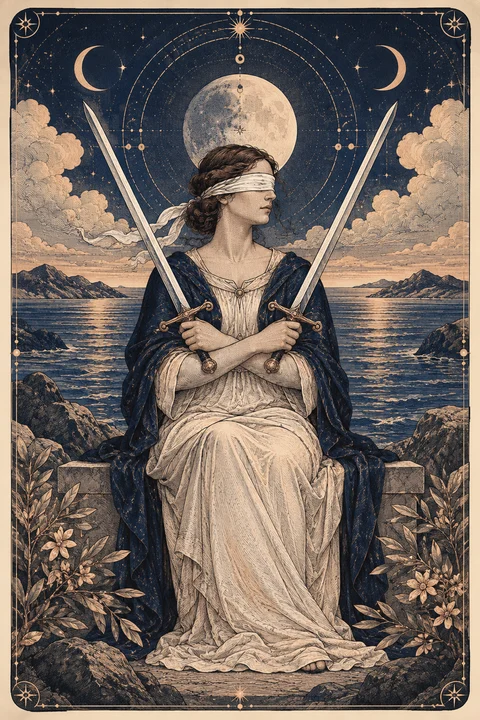
The two of swords reversed meaning traditionally signals the breaking of a mental stalemate, forced decision-making, or overwhelming cognitive overload. While the upright card represents a self-imposed pause or careful truce between opposing perspectives, its reversal reveals that the blindfold is coming off or the tension can no longer hold. Readers view this shift as an invitation to face uncomfortable truths and release intellectual paralysis.
Symbolism of the Rider-Waite-Smith Two of Swords
In the standard Rider-Waite-Smith imagery illustrated by Pamela Colman Smith, a blindfolded woman sits calmly on a stone bench beside a rippling sea. She holds two heavy, crossed swords over her chest, protecting her heart while maintaining a strict physical balance. In the sky above, a crescent moon illuminates the rocky waters, hinting at unconscious emotions beneath her deliberate cerebral composure. This composition embodies the suit of Swords, which corresponds to the element of Air, intellect, conflict, and truth.
When the card appears upright, it captures a chosen deadlock where logic attempts to suppress emotional vulnerability. The figure intentionally closes her eyes to external noise so she can weigh two opposing options without bias. When inverted, the entire posture flips upside down. The crossed blades no longer shield the torso, suggesting that external pressures or internal awakenings have broken the stance. The sea rises above the thoughts, signaling that hidden feelings are disrupting the sterile equilibrium.
Understanding the upright imagery provides essential grounding for interpreting its inverted counterpart. The swords represent discriminating intellect and communication, while the sea symbolizes the emotional waters of the subconscious mind. By turning this tableau upside down, Tarot practitioners recognize that the illusion of neutrality has dissolved. Whether the querent feels liberated or exposed, the card warns that maintaining an artificial standoff is no longer possible in their current situation.
Two of Swords Reversed Meaning in Everyday Life
At its core, the two of swords reversed meaning points to the unavoidable end of an impasse. In practical readings, this card surfaces when someone has delayed a choice for too long and outside circumstances now force their hand. Alternatively, it can indicate a sudden breakthrough where the seeker finally gathers enough facts to drop their defenses and choose a path. The blindfold slips away, showing that prolonged hesitation often creates more distress than the actual outcome of the choice itself.
Conversely, this reversal can signify extreme cognitive dissonance and information overload. Rather than finding peaceful resolution, the querent might find themselves bombarded by conflicting opinions, misleading advice, or endless digital distractions. The clear analytical faculty associated with Air degenerates into spinning thoughts, insomnia, and nervous tension. Practitioners describe this manifestation as analysis paralysis, where overthinking replaces constructive action and prevents meaningful progress.
In interpersonal affairs, this inversion commonly reflects a truce that has finally fractured. Spouses, coworkers, or friends who previously agreed to disagree may find that simmering resentments are breaking through the surface. While conflict can feel disruptive, many readers view this rupture as a healthy release of trapped energy. The card reminds us that avoiding an argument through deliberate ignorance does not resolve underlying problems; it merely postpones the inevitable conversation.
Four Lenses for Reading the Inversion
Seasoned readers often analyze reversed cards through four distinct interpretive models: blocked energy, internal expression, excess, and lack. When viewed as blocked energy, the reversed Two of Swords suggests that a vital decision is being actively obstructed by fear or stubborn refusal. The seeker wants to move forward, but an unacknowledged anxiety holds their arms rigid. Identifying the source of this resistance helps unlock the natural analytical clarity of the Swords suit.
As an internal expression, the card turns the conflict inward rather than projecting it onto an external partner or circumstance. The querent might not be arguing with a spouse or employer; instead, two personal values or beliefs are battling inside their private conscience. In this state, the individual struggles to reconcile what they think with what they feel. Giving voice to both sides of the internal debate can help restore personal equilibrium.
Through the lenses of excess and lack, the card reveals two opposite extremes of Air energy. In excess, the mind produces too much debate, endlessly questioning every detail and creating unnecessary drama. In lack, the seeker lacks sufficient clarity, acting blindly without looking at the facts or refusing to consider consequences altogether. Evaluating which extreme is active helps the reader offer nuanced guidance tailored to the querent's current psychological landscape.
Contextual Meanings in Relationships and Career
Within relationship readings, the reversed Two of Swords often heralds the unveiling of secrets or the end of silent treatments. Couples who have swept substantial grievances under the rug may find that honest communication can no longer be avoided. For single seekers, the card can highlight an internal readiness to dismantle self-protective walls that previously kept romantic partners at bay. Dropping the defensive posture carries vulnerability, yet it opens the door to genuine emotional intimacy.
In career and financial scenarios, this card commonly depicts professional forks in the road where indecision carries tangible costs. The seeker might be agonizing between two job offers, career changes, or project proposals, fearing that selecting one means losing the other. The reversal suggests that delaying the decision risks losing both opportunities. It encourages an honest appraisal of the factual data, followed by swift, committed execution rather than perpetual calculation.
Context within the overall Tarot spread also heavily dictates how this card should be synthesized. If flanked by challenging cards like the Three of Swords or The Tower, the reversal may warn of abrupt, distressing realizations. However, when paired with supportive cards such as The Star or Ace of Swords, it signals refreshing mental liberation, truthful resolution, and relief from agonizing doubts that had clouded personal direction.
Tradition, History, and Divergent Tarot Schools
The interpretation of Tarot cards varies across historical periods and hermetic traditions. In the Hermetic Order of the Golden Dawn, the Two of Swords is attributed to the moon in Libra and titled the Lord of Peace Restored. In that esoteric framework, the card represents balanced intellect, contemplation, and harmonious justice. Inversion disrupts this Libran peace, introducing strife, imbalance, and erratic mental fluctuations that disturb the tranquil equilibrium established by the number two.
Continental traditions, such as reading with the historic Tarot de Marseille, take a different approach. Marseille decks feature non-scenic pip cards, where the two curved scimitars enclose a central floral motif. Continental readers often focus on the interplay of opposing forces, negotiations, or contracts rather than psychological blindfolds. Some traditional French cartomancers do not utilize reversed cards at all, choosing instead to determine ill-dignified meanings strictly from neighboring cards and elemental dignities.
Modern psychological and intuitive readers, influenced by thinkers like Arthur Edward Waite and twentieth-century depth psychology, prioritize the seeker's inner state over rigid fortune-telling formulas. Rather than viewing the reversal as a purely negative omen, modern readers celebrate it as an emergence from denial. The card is treated as a mirror reflecting cognitive defense mechanisms, encouraging clients to explore why they chose ignorance over uncomfortable enlightenment in the first place.
Reflective Practice and Embracing Intellectual Clarity
Integrating the card into a personal self-reflection practice requires grounded inquiry and emotional honesty. Because the suit of Swords corresponds to communication, journaling serves as an exceptional tool for untangling conflicted thoughts. When this card appears in a daily draw, take time to write out both sides of an unresolved issue without judging either viewpoint. Seeing the arguments laid bare on paper often strips them of their paralyzing emotional weight.
Helpful questions for reflection include: What uncomfortable truth am I currently refusing to acknowledge? What decision would I make right now if I were not afraid of the outcome? In what areas of my life am I waiting for someone else to choose for me? Am I suffering from genuine confusion, or am I hiding behind feigned ignorance to avoid accountability? Answering these prompts directly can restore personal agency.
Ultimately, understanding the two of swords reversed meaning empowers you to step out of intellectual stalemate and step into conscious action. While confronting reality may temporarily disturb your comfort zone, remaining suspended in artificial neutrality prevents genuine growth. By dropping your protective blades and trusting your ability to navigate the waters of change, you invite clarity, truth, and genuine peace back into your everyday life.
Frequently asked questions
Is the Two of Swords reversed a positive or negative card in Tarot?
In traditional Tarot, cards are neutral symbols rather than purely positive or negative omens. While the reversed Two of Swords can signal uncomfortable tension, stress, or broken truces, many readers view it positively because it ends painful stagnation. It encourages you to face reality, gather facts, and finally resolve long-standing dilemmas.
What does the Two of Swords reversed mean for love and reconciliation?
In romance, this reversal suggests that the silent treatment or passive resistance is ending. Whether that results in reconciliation or a definitive parting depends on surrounding cards and your mutual willingness to communicate. The card indicates that you can no longer ignore relationship friction; honest dialogue is required to move forward.
How does the Two of Swords reversed differ from its upright counterpart?
Upright, the Two of Swords depicts a deliberate stalemate where someone maintains strict emotional composure to weigh choices or avoid conflict. Reversed, that fragile balance collapses. The reversal highlights either the breakthrough of clarity where the blindfold comes off, or severe cognitive overload where indecision causes chaotic mental stress.
What should I do when I pull the Two of Swords reversed in a daily draw?
When this card appears, identify any decisions you have been actively evading. Rather than waiting for circumstances to choose for you, examine the available evidence objectively. Write down your options, acknowledge underlying emotional fears, and commit to a decisive course of action to restore inner peace and mental momentum.