Why Did Strength and Justice Switch in Tarot?
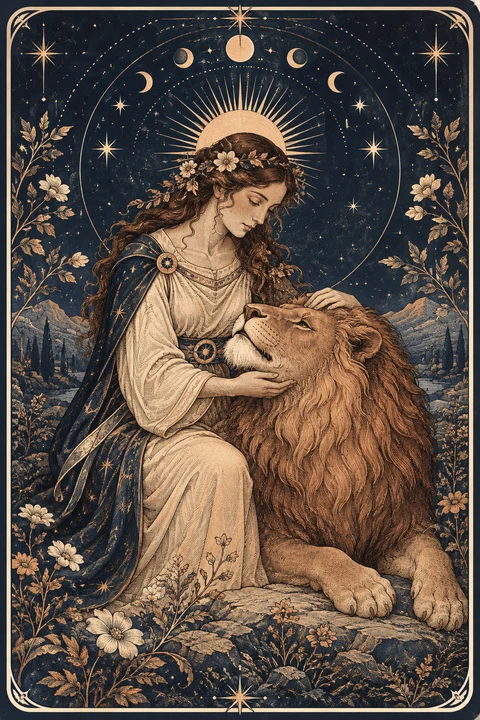
Strength and Justice switched places in modern Tarot because Arthur Edward Waite aligned the Major Arcana with the astrological order established by the Hermetic Order of the Golden Dawn. In older decks like the Tarot de Marseille, Justice held Trump VIII and Strength held Trump XI. Waite swapped them so Strength could correspond to the zodiac sign Leo and Justice could match Libra, preserving the natural sequence of the heavens.
The Historic Baseline: Justice at Eight and Strength at Eleven
To understand the modern rearrangement of the Major Arcana, one must first look at the continental pattern that preceded it. During the fifteenth and sixteenth centuries in Italy and France, early card makers developed what readers now classify as the Tarot de Marseille tradition. In these classic decks, Justice reliably occupies Trump VIII, sitting right between The Chariot and The Hermit. Strength, titled La Force in classic French printings, rests at Trump XI, positioned midway through the second septenary of the trump sequence.
This original numbering reflected an older Renaissance worldview centered on classic cardinal virtues and civic morality rather than precise astrological correspondences. Justice, Prudence, Fortitude, and Temperance represented fundamental human ideals that guided ethical conduct. Early cardmakers organized these allegorical images according to civic and Christian hierarchies of the era. The sequence served memory arts, card play, and contemplative philosophy without needing to conform to the twelve signs of the zodiac or mystical alphabets.
For centuries, card readers across continental Europe accepted this arrangement without question. When early occultists like Antoine Court de Gébelin and Eliphas Lévi began examining the cards in the late eighteenth and nineteenth centuries, they struggled to align this traditional sequence with esoteric cosmology. Lévi sensed deep Hermetic wisdom inside the deck, but the placement of Justice and Strength created friction for esoteric scholars attempting to map the Major Arcana onto systematic astrological and kabbalistic patterns.
The Golden Dawn's Astrological Blueprint
The pivotal transformation occurred in late Victorian England within the Hermetic Order of the Golden Dawn. Founded in 1888 by William Wynn Westcott, Samuel Liddell MacGregor Mathers, and William Robert Woodman, this secret society sought to synthesize Western ceremonial magic, Kabbalah, alchemy, and astrology into a single, cohesive framework. Central to their curriculum was the Sepher Yetzirah, an ancient Jewish mystical text that pairs the twenty-two letters of the Hebrew alphabet with cosmic elements, planets, and zodiac signs.
The Golden Dawn assigned the twenty-two trumps of the Major Arcana to the paths on the Tree of Life and the corresponding Hebrew letters. In this system, the letter Aleph aligned with The Fool, Beth with The Magician, and so forth down the line. Twelve of these letters represented the twelve signs of the zodiac, which naturally follow a fixed celestial order starting with Aries and moving through Taurus, Gemini, Cancer, Leo, Virgo, and Libra.
When the Golden Dawn mapped the traditional Marseille sequence against the astrological wheel, they encountered an undeniable collision. The Emperor represented Aries, The Hierophant matched Taurus, The Lovers matched Gemini, and The Chariot matched Cancer. Under the Marseille sequence, Trump VIII was Justice. However, the next zodiac sign after Cancer is Leo, the fierce and solar lion. Placing Justice, an emblem of balance and scales, in Leo while forcing Strength into Libra contradicted every principle of their astrological symbolism.
Why Did Strength and Justice Switch in Tarot Decks?
Readers frequently ask why did strength and justice switch in tarot when the cards had functioned in their original slots for hundreds of years. The answer rests entirely on the Golden Dawn's insistence on celestial harmony. Strength portrays a woman gently taming a roaring lion, which makes it an unmistakable visual and energetic match for the fire sign Leo. Justice depicts a seated figure holding an upright sword and balanced scales, reflecting the elemental air sign Libra.
To preserve the natural progression of the zodiac, MacGregor Mathers quietly swapped the two cards in the Golden Dawn's secret manuscript materials, known as Book T. By shifting Strength to position 8, Leo followed Cancer directly as it does in the night sky. The Hermit then took position 9 to represent Virgo, the Wheel of Fortune claimed position 10 as Jupiter, and Justice stepped into position 11, aligning with the sign of the scales, Libra.
This ingenious adjustment resolved the cosmological contradiction that had vexed English occultists. It created a harmonious, unbroken circuit where the symbolic narrative of the trumps echoed the visible movement of the sun through the heavens. Without this swap, the astrological attribution of the Major Arcana would have collapsed or required arbitrary breaks in the classical zodiacal sequence.
Arthur Edward Waite's Public Revelation of the Swap
For decades, this reshuffling remained a closely guarded secret accessible only to initiated members of the Golden Dawn who took vows of confidentiality. That status changed dramatically in 1909 when Arthur Edward Waite, an influential occult scholar and former member of the order, collaborated with artist Pamela Colman Smith to publish the Rider-Waite-Smith deck. Waite chose to make this esoteric modification visible to the public, officially branding Strength as VIII and Justice as XI.
Waite addressed this dramatic change with intentional coyness in his companion manual, The Pictorial Key to the Tarot. In his commentary on Strength, he wrote: 'For reasons which satisfy myself, this card has been exchanged for that of Justice, which is usually numbered eight. As the change effected will satisfy nobody without reasons, I will merely say that for myself it has reasons which are completely satisfying.' He offered no further explanation in the text, preserving the inner-order oath while establishing the change in print.
Pamela Colman Smith brought this astrological vision to life through her revolutionary, richly detailed artwork. In Strength, she crowned the maiden with a lemniscate, the symbol of infinity, and depicted her closing the jaw of a golden lion in a calm, spiritual triumph over raw instinct. In Justice, she framed the figure between twin pillars beneath a veil, echoing the equilibrating forces of the equinox that heralds the arrival of Libra.
Numerological Shifts: Eight, Eleven, and Modern Reading Traditions
Beyond astrology, the exchange of Strength and Justice fundamentally altered the numerological rhythm of the Major Arcana. In the Rider-Waite-Smith tradition, placing Strength at eight links the card with the lemniscate, endurance, resilience, and personal mastery. Eight represents balanced manifestation and the cyclical regeneration of spiritual energy. Justice at eleven becomes a master number, representing ethical clarity, karmic calibration, and an objective threshold separating the first and second halves of the Fool's spiritual journey.
Conversely, readers who work with the Tarot de Marseille celebrate the original numerological structure. In that system, Justice at eight reflects the stability of double fours, representing grounded structure, absolute equilibrium, and societal law. Strength at eleven represents the dawn of the second septenary, an initiation where raw, untamed instinct must be integrated into consciousness through spiritual courage rather than brute coercion.
Neither system is objectively superior or defective; rather, each operates within a distinct philosophical framework. Modern readers who work primarily with psychological archetypes and astrological timing usually favor the Rider-Waite-Smith sequence. Meanwhile, readers who prefer historical French methodologies, strict numerological symmetry, or open card play often find profound wisdom in the Marseille tradition where Justice remains securely at eight.
Reflecting on the Strength and Justice Switch in Tarot
When examining why did strength and justice switch in tarot, readers uncover a fascinating debate about the living evolution of symbolic languages. Divination is not a rigid doctrine carved in stone, but a rich tapestry of cultural dialogue, sacred geometry, and reflective insight. Arthur Edward Waite and the Golden Dawn did not break the Tarot; they reimagined its architecture so it could speak clearly to an audience that viewed the cosmos through the lens of esoteric astrology.
When you draw Strength or Justice in a spread, consider which numerical system resonates best with your intuitive inquiry. You might ask yourself: Does the disciplined balance of eight feel like the cool deliberation of Justice, or does it echo the patient, enduring compassion of Strength? Does eleven invite you to face an ethical reckoning, or does it challenge you to master your internal lions?
By appreciating the historical and celestial reasons behind this famous switch, you deepen your understanding of both cards. Whether you honor the centuries-old elegance of the French trumps or the solar-aligned precision of the Rider-Waite-Smith deck, recognizing the logic behind the numbers enriches your reading practice and reveals how symbolic traditions continue to evolve.
Frequently asked questions
Why is Justice numbered 8 in some decks and 11 in others?
Historic decks like the Tarot de Marseille number Justice VIII based on early Renaissance allegorical rankings and numerology. Modern English decks, starting with the 1909 Rider-Waite-Smith Tarot, number Justice XI to align the card with the zodiac sign Libra in the Golden Dawn's esoteric system.
Did Aleister Crowley keep the switch between Strength and Justice?
Yes, Aleister Crowley preserved the numerical swap in his Thoth Tarot. Crowley retained Adjustment (Justice) at position VIII and Lust (Strength) at position XI in numerical order, but he followed the Golden Dawn's astrological correspondence, attributing Lust to Leo and Adjustment to Libra.
Does the number swap change how you interpret the cards?
The core symbolic themes remain consistent, but the numerological resonance shifts. When Strength is eight, readers often emphasize infinite endurance, renewal, and gentle power. When Justice is eight, the focus turns toward structural stability, legal balance, and grounded karmic symmetry.
Which deck tradition should beginner Tarot readers choose?
Most contemporary Tarot books and tutorials in the United States rely on the Rider-Waite-Smith system, making Strength VIII and Justice XI the easiest framework for beginners. Readers interested in French history, open cartomancy, or non-astrological methods may prefer exploring the classic Marseille order.