Eight of Swords Yes or No: Tarot Meaning Explained
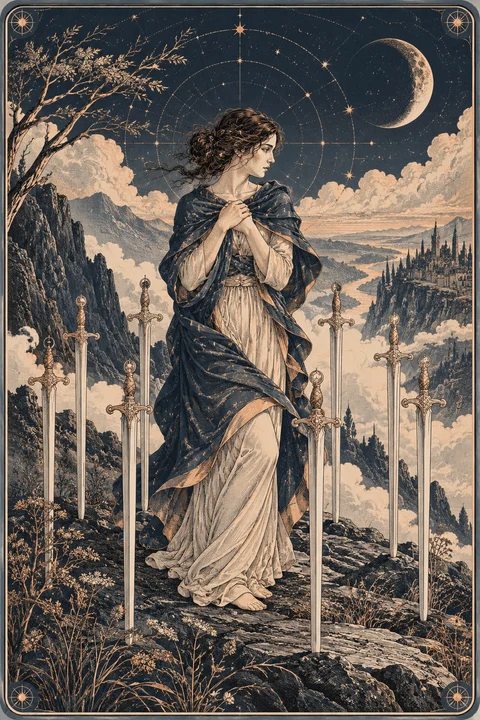
In a yes or no Tarot reading, the Eight of Swords traditionally leans toward a decisive no. This card symbolizes perceived helplessness, paralyzing self-doubt, and mental restrictions that prevent clear action. While external circumstances may feel insurmountable, the card emphasizes that your primary obstacles are often rooted in your own thought patterns rather than an unavoidable external reality.
Understanding the Symbolism of the Eight of Swords
To interpret this card accurately within any spread, one must first examine its foundational symbolism. In the traditional Rider-Waite-Smith deck, the Eight of Swords depicts a woman bound with loose cords and blindfolded, standing isolated in muddy water. Surrounding her are eight upright swords, arranged like the bars of an improvised prison. Her dress is simple, and in the distance, a castle sits upon a cliff, representing safety, structure, and social order that feel unreachable from her current position in the mire.
Crucially, the imagery contains subtle indicators of self-liberation. The swords do not encircle her completely, leaving an open path directly ahead of her feet. Furthermore, the bindings wrapped around her arms and torso are noticeably loose, suggesting that a concerted effort could easily cast them aside. The blindfold prevents her from recognizing these routes to safety, illustrating how fear and anxiety obscure existing alternatives. Practitioners often note that she is not physically locked away; she is held captive entirely by her perception of helplessness.
As part of the suit of Swords, this card aligns with the element of Air, which governs the mind, intellect, communication, and truth. Swords reflect our mental architecture, including the narratives we construct about our capabilities and limitations. When the number eight appears—a number linked in numerology with structure, movement, and material reality—it reveals that distorted thoughts have solidified into an apparent fortress. The card reflects an inner atmosphere where overthinking paralyzes volition, turning imagined worst-case scenarios into perceived destiny.
Is the Eight of Swords Yes or No in an Upright Position?
When pulled in an upright orientation during a yes or no reading, the Eight of Swords indicates a clear no. The card signals that moving forward under current conditions is ill-advised because your perception is clouded by anxiety, incomplete facts, or unexamined assumptions. Attempting to force an outcome right now would be akin to stumbling through unfamiliar terrain while blindfolded, significantly increasing the probability of error, regret, or further complication.
This negative answer should not be interpreted as an inescapable cosmic decree or an external curse. Instead, many readers view this card as a compassionate warning sign advising caution and pause. The cards are indicating that you currently lack the clarity, confidence, or psychological alignment necessary to achieve a successful outcome. The restriction you feel is real in its emotional impact, but proceeding without untangling your fears will only reinforce the very limitations you are seeking to escape.
For concrete scenarios, this meaning manifests with consistent clarity. If you ask whether you should launch a high-risk venture, make a sudden relocation, or demand an ultimatum from an acquaintance, the upright card cautions against hasty implementation. It tells you that the groundwork is not firm and your vision is compromised by fear. Before seeking a green light from circumstances, you must first remove the blindfold, examine the ground you stand upon, and dismantle self-sabotaging beliefs.
The Reversed Eight of Swords: A Shift Toward Yes?
When the Eight of Swords appears in reverse, its interpretive energy pivots significantly. Traditionally, a reversal indicates that the blindfold is slipping, the loose bindings are coming undone, and the querent is beginning to recognize the exit paths previously hidden from view. You may be waking up to your own complicity in feeling powerless, which paradoxically restores your power. The mental fog starts to clear, allowing reason and self-compassion to replace catastrophic thinking.
In a yes or no context, the reversed card leans cautiously toward a yes, or at minimum, a transformative breakthrough. It signifies that you are ready to dismantle limiting beliefs and take accountability for your next steps. If you are asking whether you can overcome an obstacle, resolve a long-standing deadlock, or find freedom from a suffocating circumstance, the reversed Eight of Swords provides an encouraging affirmative. It affirms that the worst of your mental paralysis has passed.
However, practitioners describe this reversal as an active process rather than a passive stroke of luck. Stepping out from between the swords requires stepping into the unknown, which can produce temporary discomfort or vulnerability. The card confirms that the cage door is unlatched, but you must still summon the courage to walk through it. It answers yes to personal agency, healing, and progressive movement, provided you commit to seeing reality as it truly is.
How Context Shapes the Meaning in Love, Career, and Life
Context plays an indispensable role in nuance, as cards never operate in a vacuum. In relationship readings, an upright Eight of Swords often exposes codependency, uncommunicated resentments, or feelings of being trapped. If you ask whether a romantic connection will deepen, the card warns that both partners may be walking on eggshells, constrained by fear of confrontation or abandonment. It implies that neither party is viewing the relationship through an objective lens, making genuine intimacy difficult until honesty replaces defensive silence.
Within professional and financial inquiries, the card frequently reflects imposter syndrome, bureaucratic gridlock, or feeling locked into an unfulfilling job. If you inquire about whether a promotion or business project will succeed, the card suggests that self-doubt or perceived helplessness is actively sabotaging your initiatives. You might believe that company politics or economic conditions leave you with zero options, yet the card challenges you to scrutinize whether you have genuinely explored every professional avenue available.
When applied to personal growth and daily decision-making, the card serves as a mirror for cognitive distortion. It highlights patterns of catastrophizing, rumination, and victim identity. In this territory, the card asks whether you are waiting for an external savior to rescue you from a dilemma that you have the internal power to resolve. Context reveals which specific area of your life has been surrendered to fear, guiding you precisely toward the thoughts that demand critical evaluation.
Reframing Your Question Beyond Simple Yes or No
While asking binary yes or no questions is common, it often diminishes the rich introspective value of Tarot. Complex archetypes like the Eight of Swords rarely reduce neatly to absolute binaries without losing their instructive wisdom. A flat negative can leave a seeker feeling disempowered or anxious, which inadvertently deepens the exact feelings of entrapment depicted in the imagery. Divination flourishes when used as a reflective framework rather than a deterministic pronouncement.
To extract deeper guidance, readers recommend reframing binary queries into open-ended questions focused on awareness and strategy. Instead of asking whether a situation will improve, consider asking what unexamined assumption is preventing progress. Rather than asking if you should leave a restrictive environment, explore how you can reclaim your personal sovereignty within that environment. These adjustments shift your orientation from passive expectation to proactive self-determination, transforming the cards into diagnostic instruments for conscious decision-making.
Consider asking inquiries such as: What truth am I unwilling to look at right now? Where am I giving away my authority under the pretense that I have no choice? How can I loosen the mental narratives keeping me stationary? Engaging with the cards through this deliberate approach allows the sharp intellect of the Swords suit to function as a scalpel that frees you, rather than a perimeter of blades that keeps you confined.
Navigating the Eight of Swords Yes or No Dynamic
Synthesizing the lessons of this card requires recognizing that the primary obstacle is rarely the mountain ahead, but the belief that your legs are bound. When interpreting the eight of swords yes or no dynamic, treat the traditional no as an invitation to rest, reassess, and recalibrate your inner narrative. Taking action while mentally restricted usually replicates the exact anxiety you are attempting to escape, making patience your most strategic asset.
To begin moving forward constructively, start by inventorying the assumptions you hold about your current problem. Write down the facts of your situation in one column and your emotional interpretations in another. By separating objective reality from catastrophic assumptions, you systematically untie the cords binding your arms. You will frequently find that the swords surrounding you are static monuments of past conflicts rather than active threats blocking your immediate horizon.
Ultimately, Tarot provides symbolic insight rather than fixed destiny. The Eight of Swords reminds us that freedom begins in the mind; when you choose to take off the blindfold and acknowledge your inherent capacity to choose, external barriers lose much of their power. Use this card not as a final verdict of defeat, but as a poignant mirror urging you to step forward into autonomy, clarity, and self-directed action.
Frequently asked questions
Does the Eight of Swords always guarantee a negative outcome?
No card guarantees an absolute outcome. In divination, cards reflect energetic tendencies and subconscious patterns. The Eight of Swords highlights perceptual barriers and anxiety rather than an unchangeable fate. It signals that until you address self-imposed limits and acquire clarity, forward progress remains unlikely.
What does the Eight of Swords mean for a reconciliation question?
For reconciliation, the card strongly indicates a no for the present moment. Both individuals are likely trapped in defensive thinking, past hurts, or mutual misunderstandings. Attempting to force a reunion right now will likely recreate the same painful emotional dynamics that caused the separation initially.
Can the Eight of Swords signify manipulation by other people?
While the card primarily highlights internal mental traps, surrounding cards may suggest an oppressive environment. However, the Eight of Swords emphasizes your reaction to those dynamics. It asks whether you are accepting another person's restrictive boundaries as absolute truth instead of recognizing your ability to walk away.
How does the element of Air affect this card's reading?
Air governs thoughts, communication, logic, and beliefs. Its presence demonstrates that your dilemma resides in the intellect rather than physical impossibility. By applying clear analysis, honest communication, and disciplined logic, you can dismantle the anxious thoughts that make you feel helpless.