Ten of Swords Yes or No: Tarot Meaning Explained
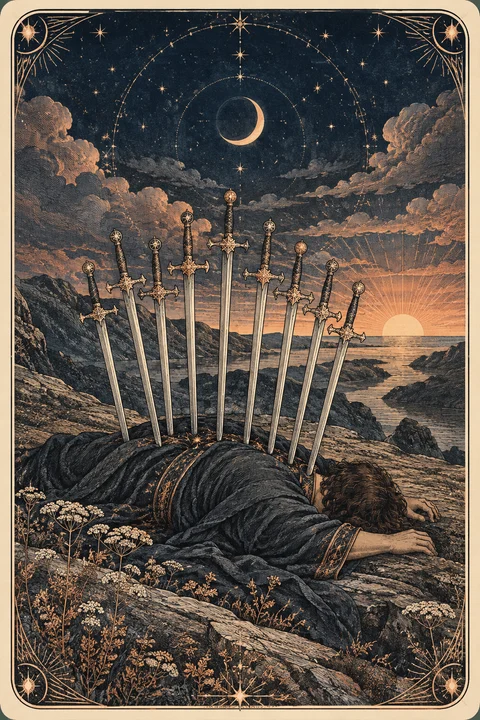
In a direct yes or no reading, the Ten of Swords is traditionally interpreted as a clear and emphatic no. Representing painful conclusions, sudden endings, exhaustion, and rock bottom, this card indicates that a situation has run its course and cannot be revived. At the same time, because the image captures the absolute end of a painful cycle, it also brings the quiet assurance that healing begins once you accept the finish line.
Understanding the Symbolism of the Ten of Swords
In traditional Rider-Waite-Smith Tarot, the Ten of Swords portrays a somber figure lying prone on the ground, draped in a red cloth with ten golden swords planted along their spine. Above this desolate scene sits an ink-black sky, yet along the distant horizon, a golden dawn begins to break across calm waters. As part of the suit of Swords, this card aligns with the element of Air, which rules the intellectual realm of thoughts, communication, beliefs, and conflict.
Tens in the Minor Arcana symbolize completion, culmination, and the natural conclusion of a numerical cycle. In the intellectual realm of Swords, this completion often manifests as mental exhaustion or a situation pushed to its absolute limit. Readers frequently observe that ten swords are dramatic overkill to defeat a single adversary, illustrating how our own persistent thought loops, catastrophic thinking, or betrayal can amplify an already difficult circumstance.
Despite its startling visual impact, the card carries a profound message of release. The worst has already happened, meaning there are no more blows left to fall. The golden horizon reminds the querent that dawn always follows the darkest hour. In contemplative practice, this archetype does not represent physical doom, but rather the unavoidable necessity of surrendering to an ending so genuine renewal can take root.
The Upright Ten of Swords Yes or No Meaning
When you pull the upright card during a simple inquiry, the ten of swords yes or no answer is overwhelmingly a no. If you are asking whether a troubled relationship will mend itself spontaneously, whether a dead-end project will suddenly succeed, or whether someone will change overnight, this card delivers an uncompromising reality check. It warns that pushing forward with your current approach will only produce further depletion and disappointment.
The upright posture demands radical honesty and acceptance. Many readers view this card as a signal that you have hit an absolute dead end, making continued struggle futile. When the Ten of Swords appears, it suggests that external forces or long-standing patterns have brought things to a halt. Fighting against the current reality will not change the outcome; instead, it prolongs the discomfort.
There is, however, an essential nuance when working with questions that carry negative phrasing. For instance, if you ask whether you should abandon an unsustainable habit or close down a failing venture, the card strongly affirms that choice. In those specific scenarios, the card acts as a definitive confirmation that walking away is both necessary and overdue, giving you permission to let go.
The Reversed Ten of Swords Yes or No Meaning
When the Ten of Swords appears reversed, its traditional interpretation shifts toward a cautious maybe or a slow, conditional yes. A reversal often indicates that the sharpest sting of a crisis has passed and the process of recuperation is underway. You may be pulling the swords out one by one, picking yourself up, and beginning to survey the landscape after an emotional or mental storm.
At the same time, practitioners describe a shadow side to this reversal. It can indicate someone who is clinging to old grievances, refusing to accept an obvious ending, or unnecessarily replaying past betrayals. If you are harboring resentment or resisting necessary closure, the reversed card warns that you are delaying your own recovery. It asks whether you are truly ready to stand up, or if you are choosing to remain lying down.
In practical readings, the reversed card suggests that positive progress is possible, provided you actively participate in your healing. The answer leans toward yes only if your question centers on whether you will recover, rebuild, or find peace after grief. If the question asks whether an old dynamic will return to how it was before the collapse, the answer remains no.
Context Matters: Love, Career, and Personal Decisions
Context always shapes card interpretation, especially in matters of love and emotional connection. If you ask whether an estranged partner will return, the Ten of Swords usually delivers a firm no, pointing to irreparable trust or emotional depletion. However, if you ask whether you are finally moving past a painful heartbreak, the card confirms that the ending is complete, signaling that your emotional slate is clearing for healthier bonds.
In professional and financial inquiries, this card highlights burnout, corporate restructuring, or unviable contracts. Asking if a precarious job is secure will typically result in a discouraging no. Yet, if you ask whether it is time to pivot toward a fresh career path, the card offers an encouraging push. It confirms that staying put will drain your vitality, while moving forward allows you to rebuild on solid ground.
Regarding personal growth, this card frequently surfaces when a person clings to rigid beliefs or self-defeating habits. Divination practitioners emphasize that the swords represent thoughts; hence, this card often mirrors the collapse of an illusion. When you stop defending an outdated mindset, the crisis evaporates, leaving space for genuine clarity and self-compassion to emerge.
Why Single Card Binary Pulls Can Be Misleading
Relying entirely on a single card for an absolute yes or no answer can easily lead to confusion, particularly with dramatic cards like the Ten of Swords. Life decisions rarely fit neatly into binary boxes, and Tarot is fundamentally designed as a rich symbolic language rather than an automated vending machine for fate. Reducing an archetypal narrative of death, rebirth, and mental truth into a one-word answer strips away valuable guidance.
Furthermore, human emotion inevitably skews how we interpret abrupt answers. When a seeker receives a sharp negative response, anxiety can trigger frantic reshuffling or repeated questions until a pleasing card appears. This practice creates spiritual noise rather than insight. Recognizing that cards reflect current trajectories and inner states helps you treat the reading as a productive mirror rather than an unalterable verdict.
To gain genuine depth, many experienced readers suggest pulling two supporting cards alongside the primary draw. A card placed to the left can illuminate the root cause of the ending, while a card placed to the right can reveal the first constructive step toward renewal. This simple three-card approach transforms a blunt negative into an actionable roadmap.
Reframing Questions Around the Ten of Swords Yes or No
If you find yourself repeatedly turning to a ten of swords yes or no inquiry, consider shifting your question toward open-ended self-reflection. Rigid questions such as will this work out keep you in a passive, waiting posture. Open-ended inquiries restore your personal agency and encourage honest introspection, helping you understand how best to navigate significant life transitions.
Instead of asking whether an exhausting commitment will suddenly improve, you might ask what lesson this ending offers you, or what boundaries you need to establish to protect your energy. If you are experiencing conflict with a colleague or friend, ask what perspective you are overlooking rather than asking who will win the dispute. These thoughtful adjustments yield practical insights you can actually apply.
Consider journaling on prompts such as what truths am I avoiding right now, or how can I gently release what is no longer serving my highest good. By using the cards to examine your inner thoughts, fears, and hopes, you step away from disempowering superstition and step toward deliberate, conscious growth.
Finding the Dawn in the Ten of Swords Yes or No
While facing the ten of swords yes or no result can feel daunting, the card carries an indispensable gift of finality. Lingering in ambiguous situations often drains more vitality than confronting an uncomfortable truth directly. Once an ending is clearly acknowledged, the suspense vanishes, and you can direct all your energy toward restoration and future endeavors.
Remember that the golden sunlight piercing the horizon is an intentional part of the artwork. Every ending clears the ground for an unwritten chapter. By accepting what cannot be changed, you liberate yourself from the exhaustion of holding up a collapsing structure. The card urges you to lay down your mental burdens and rest before beginning your next climb.
Ultimately, the Tarot functions as a reflective companion for life's inevitable peaks and valleys. When the Ten of Swords appears, treat it not as a punishment, but as a compassionate permission slip to stop struggling against the inevitable. Acknowledge the pain, honor the journey, and trust that the horizon holds a promising dawn.
Frequently asked questions
Is the Ten of Swords always a negative card in a reading?
Not necessarily. While the upright card denotes painful endings and distress, it also signals the absolute conclusion of a painful cycle. Because the worst has already occurred, the card offers relief from ongoing anxiety and promises that recovery is ready to begin.
What does the Ten of Swords mean for a love outcome?
In relationship inquiries, this card traditionally signifies a definitive breakup, profound heartbreak, or the collapse of trust. It indicates that the partnership in its current form has ended. For singles, it suggests healing from past betrayals before opening your heart again.
Can the Ten of Swords reversed mean a second chance?
Rarely does it signify returning to an old situation as it was. Instead, the reversed card indicates personal survival, picking up the pieces, and recovering your vitality. It represents personal renewal rather than reviving a dynamic that previously collapsed.
Why does the Rider-Waite-Smith card show ten swords for one person?
The imagery deliberately uses visual hyperbole to represent the element of Air and the mind. Ten swords emphasize how runaway mental anguish, catastrophic thoughts, and overanalyzing can intensify a crisis, reminding querents that much of their suffering stems from mental resistance.